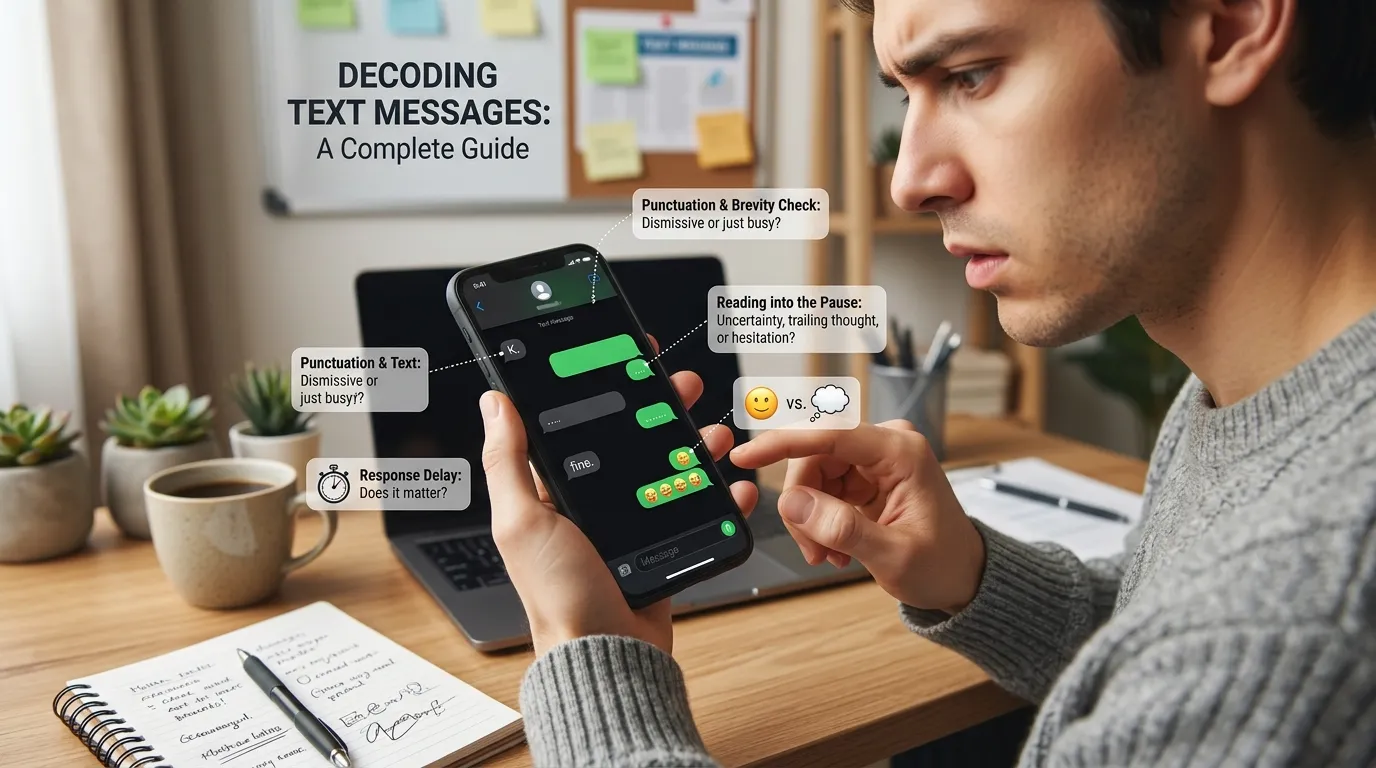
Text messages are short, fast, and convenient—but they can also be surprisingly difficult to understand. A simple “k,” a missing emoji, or a message that ends with “…” can make you wonder whether someone is annoyed, joking, flirting, being sarcastic, or simply busy. Decoding text messages means looking beyond the literal words and understanding the abbreviations, emojis, punctuation, tone, context, and social cues that shape digital communication.
Today, people use texting across nearly every part of life. You may need to interpret text message abbreviations, understand slang in texting, figure out what an emoji means, or determine whether a short reply has a hidden emotional meaning. The same message can even mean different things depending on whether it comes from a friend, romantic partner, coworker, stranger, or family member.
This guide explains how to decode text messages accurately without overthinking every word. You’ll learn how common texting expressions work, what popular abbreviations mean, how punctuation changes tone, how emojis influence meaning, and how context helps reveal someone’s actual intention. We’ll also examine texting on social media platforms such as TikTok, Instagram, Snapchat, Discord, Reddit, and gaming communities.
Most importantly, you’ll learn a practical rule: don’t decode a text message from the words alone. Meaning comes from the combination of language, context, relationship, timing, and communication habits.
What Does Decoding Text Messages Mean?
Decoding text messages means interpreting the words, abbreviations, emojis, punctuation, tone, context, and implied meaning within a digital conversation.
For example, someone texting:
“Sure.”
could genuinely mean “Yes, that’s fine.”
But depending on the conversation, it could also communicate annoyance, disappointment, hesitation, or sarcasm.
Compare these:
- “Sure!”
- “Sure 😊”
- “sure”
- “Sure.”
- “SURE 😂”
- “sure…”
The basic word has not changed, but the emotional impression can change dramatically.
That’s why text message interpretation requires more than looking up individual words. You need to consider the entire conversation.
Why Is Decoding Text Messages Important?
Texting removes many of the communication signals people normally rely on in face-to-face conversations.
When talking in person, you can observe:
- Facial expressions
- Voice volume
- Tone
- Body language
- Eye contact
- Pauses
- Gestures
- Immediate reactions
Text messages remove most of those signals.
As a result, readers often fill in the missing information themselves.
This can create misunderstandings.
For example:
Person A: “Are you coming?”
Person B: “Maybe.”
Depending on the context, “Maybe” could mean:
- “I’m not sure yet.”
- “Probably not.”
- “I don’t want to commit.”
- “Convince me.”
- “I’m joking.”
- “I’m busy and haven’t decided.”
The surrounding conversation determines which interpretation makes sense.
The Most Important Factors When Decoding a Text
When trying to understand a confusing message, examine these factors in order.
1. Literal Meaning
Start with what the person actually said.
Don’t immediately assume there is a hidden message.
If someone says, “I’m tired,” the simplest interpretation is usually that they’re tired.
2. Context
Look at the messages before and after it.
A sentence can have completely different meanings depending on what happened earlier.
3. Relationship
The same expression can mean something different between:
- Close friends
- Romantic partners
- New dating partners
- Parents and children
- Coworkers
- Managers and employees
- Strangers
4. Communication Style
Some people naturally send short messages.
Others write paragraphs.
Someone who normally sends detailed responses but suddenly replies “ok” may be communicating something different from someone who always writes “ok.”
5. Timing
A message sent at 2 a.m. may have a different context from the same message sent during working hours.
Likewise, a reply after several hours may simply mean the person was unavailable.
6. Punctuation and Formatting
Periods, exclamation points, capitalization, line breaks, and ellipses can influence perceived tone.
7. Emojis and GIFs
Visual elements can soften, emphasize, or completely change a message.
Common Text Message Abbreviations and Their Meanings
Texting culture has created hundreds of abbreviations.
Here are some of the most common:
| Texting Term | Meaning | Typical Tone |
|---|---|---|
| LOL | Laughing out loud | Casual |
| LMAO | Laughing very hard | Informal |
| OMG | Oh my God | Surprise/excitement |
| BTW | By the way | Casual |
| IDK | I don’t know | Casual/uncertain |
| IDC | I don’t care | Casual or dismissive |
| IMO | In my opinion | Conversational |
| IMHO | In my humble opinion | Informal |
| TBH | To be honest | Direct/candid |
| FYI | For your information | Informational |
| IRL | In real life | Casual |
| BRB | Be right back | Informal |
| AFK | Away from keyboard | Gaming/chat |
| TTYL | Talk to you later | Casual |
| NVM | Never mind | Casual |
| RN | Right now | Casual |
| FR | For real | Emphasis/agreement |
| W | Win | Positive |
| L | Loss | Negative |
| HMU | Hit me up | Invitation |
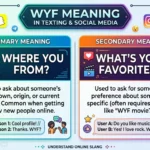
| WYD | What are you doing? | Casual |
| WYA | Where are you at? | Casual |
| IMO | In my opinion | Conversational |
| OMW | On my way | Informal |
| NP | No problem | Friendly |
| DM | Direct message | Social media |
| PM | Private message | Online communication |
Remember that abbreviations are not universal. A person’s age, community, country, platform, and interests can influence which terms they use.
Texting Slang: Why Context Matters
Texting slang evolves quickly.
Words that are common among younger users may sound unusual to someone unfamiliar with internet culture.
For example, “FR” usually means “for real.”
“That movie was amazing fr.”
Here, “fr” emphasizes sincerity.
But:
“FR??”
can communicate surprise or disbelief.
Similarly, “W” can mean a win or something positive:
“You got the job? W!”
An “L” usually represents a loss:
“I missed the deadline. Big L.”
These expressions appear frequently in social media comments, gaming chats, Discord servers, and casual texting.
How to Decode Emojis in Text Messages
Emojis aren’t merely decorative. They can function as emotional punctuation.
Consider:
“Okay.”
versus:
“Okay 😊”
The emoji makes the second message appear warmer.
However, emoji interpretation is highly personal.
Common Emoji Interpretations
| Emoji | Common Meaning | Possible Context |
|---|---|---|
| 😂 | Strong laughter | Funny situation |
| 😭 | Crying or intense emotion | Sadness, laughter, exaggeration |
| ❤️ | Love, affection, appreciation | Romance or friendship |
| 😂 | Laughing hard | Humor |
| 😭 | Overwhelmed emotion | Sadness or exaggerated reaction |
| 😭💀 | Extremely funny/shocked | Internet slang |
| 😏 | Smirking | Flirting, teasing, suggestiveness |
| 👀 | Looking/noticing | Interest or curiosity |
| 🙃 | Awkwardness/irony | Frustration or humor |
| 🤨 | Suspicion | Questioning something |
| 😭🙏 | Emotional plea | Humor, gratitude, desperation |
| 💀 | “I’m dead” | Something is extremely funny/shocking |
| 🔥 | Excellent/impressive | Praise |
| 🫡 | Respect/agreement | Support or acknowledgment |
The Same Emoji Can Have Different Meanings
Consider 😭.
Traditionally, it means crying.
Online, however, someone might write:
“That video was so funny 😭”
They aren’t necessarily sad. They’re expressing intense amusement.
Likewise, 💀 may literally represent death, but in internet slang it often means:
“That was unbelievably funny.”
This is why decoding emojis in text messages requires cultural and conversational context.
What Does Punctuation Mean in Texting?
Punctuation can strongly influence perceived tone.
The Period
Compare:
“Okay”
with:
“Okay.”
The second can sometimes feel more formal or final.
But don’t automatically assume the person is angry. Many people simply use normal punctuation.
The Exclamation Point
“Okay!”
usually sounds more enthusiastic or friendly.
Three Dots
“Okay…”
may communicate hesitation, uncertainty, disappointment, suspense, or an unfinished thought.
Multiple Exclamation Points
“WHAT!!!”
usually indicates strong emotion.
Question Marks
“Really?”
can express curiosity.
“Really??”
may express surprise.
“Really???”
can suggest disbelief or shock.
The key is to consider the sender’s normal writing style.
How to Decode “K,” “OK,” “Okay,” and “Okk”
Short responses are among the most frequently overanalyzed text messages.
“K”
Often feels abrupt.
Possible meanings include:
- Acknowledgment
- Irritation
- Hurry
- Disinterest
- Casual agreement
“OK”
Usually neutral.
“Okay”
Often feels slightly warmer or more conversational.
“Okayyy”
May suggest playfulness, teasing, excitement, or reluctance depending on context.
“Okkk”
Often indicates a casual or playful tone.
But these aren’t universal rules.
If someone always writes “K,” the word may have no hidden emotional significance.
How to Decode “LOL”
“LOL” originally meant laughing out loud.
Today, it can serve several functions.
Genuine laughter
“LOL that was hilarious.”
Softening a statement
“You’re ridiculous lol.”
The “lol” can make criticism sound less harsh.
Filling conversational space
“Yeah lol.”
In this case, it may not indicate actual laughter at all.
Nervousness
“I totally forgot about the meeting lol.”
Here, “lol” may soften embarrassment.
How to Decode “Haha”
“Haha” is another highly context-dependent expression.
Compare:
- “haha”
- “Haha”
- “hahaha”
- “HAHAHAHA”
- “haha…”
- “haha 😂”
They can indicate anything from mild amusement to genuine laughter to awkwardness.
A single “haha” doesn’t automatically mean someone disliked what you said.
How to Decode Text Messages in Dating
Texting becomes especially complicated in romantic situations because people naturally look for emotional signals.
Suppose someone writes:
“I had fun tonight :)”
That generally suggests positive feelings.
But:
“I had fun tonight.”
can feel more neutral.
Again, this doesn’t prove romantic interest or disinterest. It simply illustrates how digital tone can be perceived.
Signs That May Suggest Interest
Depending on context, someone may appear interested if they:
- Initiate conversations
- Ask follow-up questions
- Remember details
- Respond consistently
- Use playful language
- Suggest future plans
- Continue conversations rather than ending them
- Show curiosity about your life
Signs That May Suggest Distance
Potential signs include:
- Consistently one-word responses
- Rarely initiating conversations
- Frequently ending conversations quickly
- Avoiding plans repeatedly
- Giving vague responses without follow-up
However, these are patterns, not proof.
Someone may text briefly because they’re busy, stressed, tired, or simply not a frequent texter.
Decoding Text Messages From a Crush
When you’re emotionally invested, it’s easy to overinterpret tiny details.
For example:
“Goodnight :)”
could make you wonder whether the smiley face has romantic significance.
Usually, one message isn’t enough to establish someone’s feelings.
Look for repeated behavior instead.
Pattern beats punctuation.
If someone consistently makes time for you, initiates conversations, asks questions, and wants to meet in person, those behaviors are generally more informative than whether they used one emoji.
Decoding Text Messages From Friends
Friendship texting is usually more relaxed.
Friends may use:
- Inside jokes
- Sarcasm
- Memes
- Slang
- Short responses
- Nicknames
- Reaction images
- Excessive emojis
A friend saying:
“Bro 😭”
might communicate laughter, disbelief, sympathy, or frustration.
Only the surrounding context reveals which one.
Decoding Text Messages at Work
Workplace messages require more caution.
A coworker’s:
“Please send the file.”
isn’t necessarily rude.
It may simply be direct.
Similarly:
“Thanks.”
isn’t automatically passive-aggressive.
Professional communication often prioritizes efficiency over emotional expression.
Better Workplace Interpretation
Before assuming hostility, ask:
- Is the message clear?
- Is there an actual negative statement?
- Does the sender normally communicate this way?
- Is the situation urgent?
- Could the message simply be concise?
Don’t treat every short workplace message as an emotional signal.
Decoding Text Messages on Social Media
Digital communication differs by platform.
TikTok
TikTok comments frequently use:
- Slang
- Memes
- Irony
- Abbreviations
- Viral phrases
- Emojis
- Deliberate exaggeration
A comment may make little sense without understanding the trend behind it.
Instagram messaging often combines:
- Text
- Reactions
- Stories
- GIFs
- Reels
- Emojis
- Voice messages
A reaction to a story can also function as a conversation opener.
Snapchat
Snapchat communication often relies heavily on:
- Images
- Short captions
- Emojis
- Streak-related language
- Informal abbreviations
Discord
Discord has particularly strong community-specific language.
Gaming, fandom, programming, and hobby communities may each develop their own vocabulary.
Reddit slang often includes terms such as:
- OP — Original poster
- AMA — Ask Me Anything
- TIL — Today I Learned
- TL;DR — Too long; didn’t read
- IMO — In my opinion
- ELI5 — Explain Like I’m Five
Meaning depends heavily on the community or subreddit.
Decoding Text Messages in Gaming
Gaming communication is often extremely compressed because players need to communicate quickly.
Common terms include:
- GG — Good game
- GLHF — Good luck, have fun
- AFK — Away from keyboard
- OP — Overpowered
- NPC — Non-player character
- XP — Experience points
- DPS — Damage per second
- RNG — Random number generation
- W — Win
- L — Loss
For example:
“GG WP”
means:
“Good game, well played.”
A message such as:
“He’s OP”
usually means the player or character is considered unusually powerful.
Decoding Text Messages and Sarcasm
Sarcasm is one of the hardest things to identify through text.
Consider:
“Wow, great job.”
Depending on context, this could be sincere praise or sarcasm.
Without vocal tone or facial expression, the reader has to infer the speaker’s intention.
Look for:
- Contradiction between words and situation
- Exaggeration
- Familiar joking patterns
- Emojis
- Previous conversation
- Shared humor
If you’re uncertain, don’t assume sarcasm.
How to Tell If a Text Message Is Passive-Aggressive
Passive-aggressive communication can be difficult to distinguish from normal brevity.
Potential examples include:
“Fine.”
“Whatever.”
“It’s okay.”
“Do what you want.”
“Sure.”
These expressions can be passive-aggressive in certain situations, but they aren’t automatically passive-aggressive.
The surrounding conversation matters.
For example:
Person A: “Can we reschedule?”
Person B: “Sure.”
This could simply mean agreement.
But:
Person A: “I canceled again without asking you.”
Person B: “Sure.”
Here, the context may suggest frustration or sarcasm.
A Practical Method for Decoding Any Text Message
Use this seven-step method.
Step 1: Read the Entire Conversation
Don’t interpret one sentence in isolation.
Step 2: Identify the Literal Meaning
What does the message explicitly say?
Step 3: Consider the Context
What happened before the message?
Step 4: Compare Their Usual Style
Is this normal behavior for the sender?
Step 5: Examine Digital Cues
Look at:
- Emojis
- Punctuation
- Capitalization
- Abbreviations
- Message length
- Response time
Step 6: Consider Alternative Explanations
Don’t immediately choose the most negative interpretation.
Step 7: Ask If the Meaning Matters
If the misunderstanding could affect a relationship, project, or important decision, ask directly.
For example:
“Just checking—did you mean that seriously?”
A quick clarification is often better than hours of speculation.
Common Mistakes When Decoding Text Messages
Mistake 1: Assuming Every Short Reply Is Rude
Some people are simply concise texters.
Mistake 2: Treating Response Time as a Definite Emotional Signal
A delayed response doesn’t automatically mean someone is ignoring you.
Mistake 3: Overanalyzing Emojis
One emoji rarely provides enough evidence to determine someone’s feelings.
Mistake 4: Ignoring Personal Communication Style
Someone who normally uses periods may not suddenly be angry because they used one.
Mistake 5: Assuming Internet Slang Has One Universal Definition
Language changes across communities.
Mistake 6: Ignoring Cultural Differences
People from different countries or age groups may use punctuation, emojis, and abbreviations differently.
Text Message Meaning vs. Intended Meaning
One of the most important distinctions in digital communication is the difference between what someone writes and what the reader perceives.
Imagine:
“That’s interesting.”
The sender may mean:
“I genuinely want to know more.”
The reader may interpret:
“That’s not interesting.”
Both interpretations are possible because text lacks vocal tone.
This is why effective digital communication often requires clarity.
Summary Table: Decoding Text Messages at a Glance
| Category | What to Look For | What It Can Tell You |
|---|---|---|
| Words | Literal language | Basic message |
| Slang | Internet expressions | Cultural/contextual meaning |
| Abbreviations | LOL, IDK, TBH, FR | Informal tone or emphasis |
| Emojis | 😂, ❤️, 👀, 💀 | Emotional cues |
| Punctuation | Periods, !, ?… | Possible tone |
| Capitalization | ALL CAPS | Emphasis or strong emotion |
| Timing | Immediate/late reply | Possible availability, not definite intent |
| Length | One word vs. paragraph | Engagement or communication style |
| Context | Previous messages | Most important interpretive clue |
| Relationship | Friend, partner, coworker | Changes likely meaning |
| Platform | TikTok, Discord, Reddit, etc. | Community-specific language |
How Texting Language Has Evolved
Text messaging originally developed around technical limitations.
Early mobile phones made typing difficult. SMS messages were also limited in length, encouraging concise communication.
Users developed shortcuts such as:
- LOL
- BRB
- TTYL
- IDK
- BTW
As smartphones became widespread, typing became easier, but abbreviated communication didn’t disappear.
Instead, texting language expanded.
Modern communication now includes:
- Emojis
- GIFs
- Memes
- Stickers
- Voice notes
- Reactions
- Short-form video
- Internet slang
- Platform-specific terminology
Texting has therefore evolved from simply sending short written messages into a complex digital language system.
Is Texting Slang Changing?
Yes. Online vocabulary changes rapidly.
New expressions can become popular through:
- TikTok
- YouTube
- Twitch
- Discord
- Gaming communities
- X and other social platforms
A phrase can become mainstream within months and later disappear.
This means that decoding text messages is partly an exercise in understanding current digital culture.
How to Avoid Misunderstanding Text Messages
If you’re the sender, make your meaning easier to understand.
Instead of:
“Fine.”
Try:
“Sure, that’s fine with me.”
Instead of:
“We need to talk.”
which can sound alarming, try:
“I’d like to talk about the schedule when you have a minute.”
Clear communication reduces unnecessary anxiety and confusion.
When You Should Ask for Clarification
You don’t need to decode everything yourself.
Ask for clarification when:
- The message affects an important decision.
- You aren’t sure whether someone is joking.
- The tone appears hostile.
- The relationship could be affected.
- Instructions are unclear.
- A workplace message could be interpreted multiple ways.
Simple questions work well:
“What did you mean by that?”
or:
“Just checking—are you upset?”
or:
“I might be reading this wrong. Can you clarify?”
Direct communication is usually more reliable than guessing.
Frequently Asked Questions
What does decoding a text message mean?
Decoding a text message means interpreting not only the literal words but also the slang, abbreviations, emojis, punctuation, context, timing, and relationship between the people communicating.
How can I tell what someone really means in a text?
Start with the literal meaning, then consider the surrounding conversation, the person’s normal texting style, the relationship, and the situation. Look for patterns rather than relying on one word, emoji, or punctuation mark.
Does a period mean someone is angry when texting?
Not necessarily. A period can make a message feel more formal or final, but many people use normal punctuation automatically. You need to compare it with the person’s usual texting habits.
What does “K” mean in a text?
“K” commonly means “okay,” but it can sometimes sound abrupt or dismissive. Its actual meaning depends on the conversation and the sender’s communication style.
Why do people use “LOL” when nothing is funny?
“LOL” has evolved beyond literal laughter. People may use it to soften a statement, acknowledge awkwardness, make a message friendlier, or maintain a casual conversational tone.
What does 💀 mean in texting?
The skull emoji often means “I’m dead” figuratively. In modern internet slang, it commonly expresses extreme amusement, disbelief, embarrassment, or shock rather than literal death.
How do you know if someone is flirting through text?
Look for consistent patterns such as playful conversation, personal questions, compliments, initiating conversations, and attempts to spend time together. A single emoji or phrase isn’t enough to prove romantic interest.
Why are text messages so easy to misunderstand?
Text messages usually lack vocal tone, facial expressions, and body language. Readers therefore have to infer emotional meaning from limited cues, which can lead to different interpretations.
Is it possible to accurately decode every text message?
No. Text interpretation is probabilistic rather than certain. Even careful analysis cannot reveal someone’s private intention with complete accuracy. When the meaning matters, direct clarification is more reliable than guessing.
Final Takeaway
Decoding text messages isn’t simply about translating abbreviations or searching for the meaning of an emoji. It’s about understanding digital communication as a combination of words, context, culture, timing, tone, relationships, and behavioral patterns.
The most useful principles are simple:
- Start with the literal meaning.
- Read the surrounding conversation.
- Learn common texting slang and abbreviations.
- Consider emojis and punctuation as supporting clues.
- Compare the message with the sender’s normal communication style.
- Don’t automatically assume a short reply is rude.
- Don’t treat response time as proof of someone’s feelings.
- Consider multiple interpretations before choosing the most negative one.
- Pay attention to patterns rather than isolated messages.
- Ask for clarification when the stakes are high.
Above all, remember that text messages are easy to misread. A “sure,” “okay,” emoji, or delayed response rarely tells the entire story by itself.
The best way to decode a message is not to become an expert at guessing hidden meanings. It’s to become better at understanding context—and, when necessary, communicating directly. That approach makes texting clearer, reduces unnecessary misunderstandings, and helps you navigate everything from casual conversations and social media slang to dating, friendships, gaming, and professional communication with much greater confidence.