If someone sends you “SFS?” in a text, Snapchat message, Instagram DM, or social media comment, they are usually asking about a mutual promotion or exchange. But the exact meaning of SFS can change slightly depending on the platform and conversation.
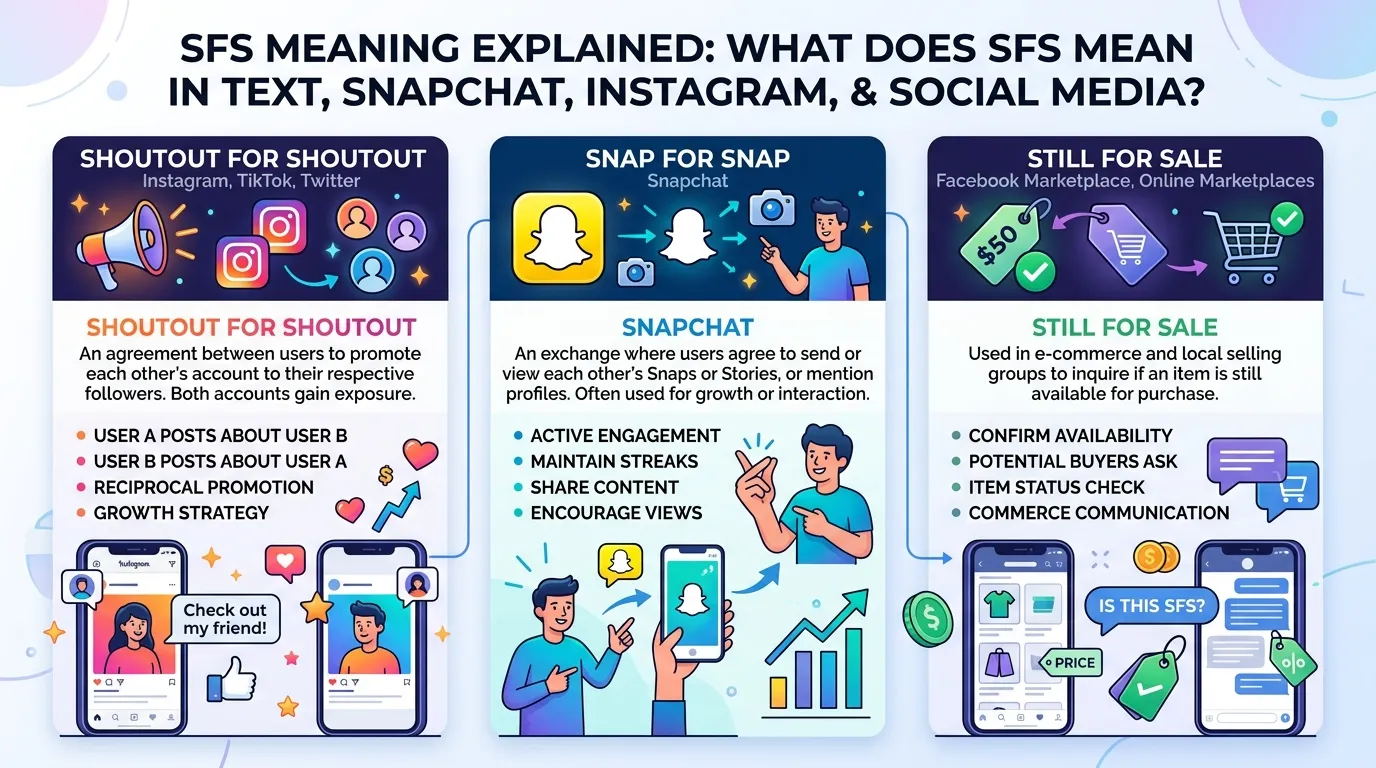
The most common meaning is “Shoutout for Shoutout,” which means two people agree to promote each other’s profiles, posts, or content. On Snapchat, SFS is also commonly understood as “Snap for Snap,” referring to an exchange of Snaps or mutual promotion. Some users also use it to mean “Spam for Spam,” where both people agree to interact with or promote each other’s content.
Understanding SFS meaning in text is useful because the abbreviation is strongly connected to social media culture, especially audience growth, follower exchanges, shoutouts, and content promotion. If someone simply writes “SFS,” knowing the context can help you understand whether they want a shoutout, a Snap exchange, or another form of reciprocal engagement.
This guide explains what SFS means, where it came from, how people use it on Snapchat, Instagram, TikTok, Reddit, Discord, and texting apps, what it means in different situations, how to respond, and how it compares with related expressions such as F4F, L4L, and share for share.
What Does SFS Mean?
SFS most commonly means “Shoutout for Shoutout.”
It describes an agreement where two social media users promote each other. One person gives the other person a shoutout, and the other returns the favor.
In simple terms:
You promote me, and I promote you back.
For example, imagine that you run a small Instagram account and another creator has a similar audience. You might message them:
“Want to do SFS?”
If they agree, you might post their account to your Story, tag them, and encourage your followers to check out their profile. They then do something similar for you.
The goal is usually to gain visibility, followers, profile visits, views, or engagement.
On Snapchat, however, SFS is particularly associated with “Snap for Snap.” The basic idea remains reciprocal: users exchange Snaps or promote each other to increase visibility.
SFS Meaning at a Glance
| Detail | Explanation |
|---|---|
| SFS meaning | Shoutout for Shoutout |
| Snapchat meaning | Snap for Snap |
| Another meaning | Spam for Spam |
| Main purpose | Mutual promotion or engagement |
| Common platforms | Snapchat, Instagram, TikTok, and other social platforms |
| Tone | Casual, social, promotional |
| Usually used by | Creators, influencers, businesses, and social media users |
| Similar terms | F4F, L4L, S4S, share for share |
| Typical message | “SFS?” or “Anyone want to SFS?” |
What Does SFS Stand For?
The most common expansion of SFS is:
SFS = Shoutout for Shoutout
The phrase describes a reciprocal promotional arrangement.
A “shoutout” is essentially a public mention or recommendation of another account. When two people agree to exchange shoutouts, each person exposes the other to their own audience.
For example:
Person A: “SFS?”
Person B: “Sure! Story or post?”
Person A: “Story works. I’ll post yours tonight.”
Person B: “Perfect. I’ll post yours too.”
Here, SFS is not simply asking someone to follow an account. It is asking for a mutual promotional exchange.
What Does SFS Mean on Snapchat?
On Snapchat, SFS commonly means “Snap for Snap.” It can refer to exchanging Snaps or participating in a mutual promotion arrangement.
Snapchat developed its own vocabulary around Snaps, Stories, streaks, usernames, and audience growth. As a result, the letters SFS can have a slightly different interpretation there than they do on Instagram.
For example:
“SFS?”
could mean:
“Do you want to exchange Snaps/promote each other?”
Or:
“SFS on my story?”
could indicate that the person wants a reciprocal Story promotion.
Snapchat SFS Example
Imagine two Snapchat users who both want more views.
One writes:
“Hey, SFS?”
The other responds:
“Yeah, send me your username.”
They may then post each other’s usernames or accounts to their Stories.
The exact mechanics can vary between users, so if the request is unclear, asking “Do you mean Snap for Snap?” is perfectly reasonable.
What Does SFS Mean on Instagram?
On Instagram, SFS usually means “Shoutout for Shoutout.”
It is often used when two accounts want to promote each other through:
- Instagram Stories
- Posts
- Reels
- Captions
- DMs
- Profile recommendations
- Tagged content
For example:
“Anyone down for SFS?”
usually means:
“Does anyone want to promote each other?”
A creator might post another creator’s account and say:
“Check out @example — amazing content!”
The other creator then gives a similar recommendation.
This makes SFS a form of cross-promotion.
Some users also use SFS to mean “Spam for Spam,” especially when the exchange involves multiple likes or comments rather than a single public shoutout.
Example of Instagram SFS
User A: “Want to SFS?”
User B: “Sure! How many followers?”
User A: “We’re pretty close. Let’s do Stories.”
User B: “Sounds good.”
The important part is that both sides are expected to provide comparable promotional value.
What Does SFS Mean on TikTok?
On TikTok, SFS can also be used as a request for mutual promotion or sharing.
The meaning is generally less standardized than on Snapchat, so context matters.
For example, someone might comment:
“SFS?”
under a creator’s video.
They could be asking whether the two accounts can promote each other.
Another person might say:
“DM me for SFS.”
That usually suggests they want to arrange a reciprocal promotion privately.
TikTok users may also use related phrases such as:
- S4S — Share for Share
- F4F — Follow for Follow
- L4L — Like for Like
- C4C — Comment for Comment
These expressions all involve some type of reciprocal social media activity, but they are not interchangeable.
What Does SFS Mean in Text Messages?
If someone sends SFS in a normal text message, the safest interpretation depends on the surrounding conversation.
If you were discussing Instagram, Snapchat, TikTok, followers, or content, SFS probably refers to Shoutout for Shoutout or Snap for Snap.
For example:
“I just started a new account. SFS?”
Here, the person is almost certainly asking about mutual promotion.
But if the conversation has nothing to do with social media, you should not automatically assume that SFS has one universal meaning. Acronyms can have different meanings in different communities.
The context is the key.
What Does SFS Mean in a DM?
In a direct message, SFS is usually a short way of proposing a reciprocal promotional exchange.
For example:
“SFS?”
“You wanna do SFS?”
“Anyone up for SFS?”
“SFS on IG?”
These messages are usually casual and direct.
The person may not explain the full phrase because SFS is familiar to people who regularly use social media slang.
What Does “SFS?” Mean Specifically?
When someone sends only:
“SFS?”
they are usually asking:
“Do you want to do a shoutout-for-shoutout?”
On Snapchat, it may instead mean:
“Do you want to do Snap-for-Snap?”
If you’re unsure, a simple response is:
“Sure—what do you mean by SFS?”
There is nothing awkward about asking. In fact, it can prevent misunderstandings.
What Does SFS Mean on Social Media?
Across social media, SFS is primarily associated with mutual promotion.
The basic process is straightforward:
- Person A wants more visibility.
- Person A finds another relevant account.
- Person A asks for SFS.
- Person B agrees.
- Person A promotes Person B.
- Person B promotes Person A.
- Both audiences are exposed to the other account.
This can be useful when two accounts have similar audiences or complementary content.
For example, a fitness creator might partner with another fitness creator.
A home decor account might promote another home decor account.
A food creator might exchange shoutouts with another food creator.
The more relevant the audiences are to each other, the more useful the exchange can be.
What Does “Spam for Spam” Mean?
Another interpretation of SFS is “Spam for Spam.”
In this context, “spam” does not necessarily mean unwanted junk messages.
Instead, users may use it to describe a reciprocal burst of engagement, such as:
- Multiple likes
- Several comments
- Story interactions
- Profile visits
- Content engagement
For example:
“SFS? I’ll spam your posts if you spam mine.”
Here, the person is proposing an exchange of engagement.
This meaning is less universal than Shoutout for Shoutout, so context becomes especially important.
If someone says “SFS” and then starts talking about liking or commenting on posts, they may mean Spam for Spam rather than a traditional shoutout.
Is SFS the Same as Share for Share?
Not exactly, although the concepts are closely related.
Share for Share generally means:
You share my content, and I share yours.
Shoutout for Shoutout generally means:
You promote my account, and I promote yours.
In practice, people sometimes use these expressions almost interchangeably.
For example, one person may share an Instagram Story featuring another account and call it a “shoutout,” while another person may simply call the same action a “share.”
The exact terminology depends on the platform and community.
SFS vs. F4F vs. L4L
SFS is often confused with other social media abbreviations.
| Acronym | Meaning | What is exchanged? |
|---|---|---|
| SFS | Shoutout for Shoutout | Promotion |
| S4S | Share for Share | Content shares |
| F4F | Follow for Follow | Followers |
| L4L | Like for Like | Likes |
| C4C | Comment for Comment | Comments |
| SFS on Snapchat | Snap for Snap | Snaps/promotional exposure |
The difference matters because agreeing to an SFS does not automatically mean you have agreed to follow someone.
SFS vs. F4F
SFS: “I’ll promote your account if you promote mine.”
F4F: “I’ll follow you if you follow me.”
These are different arrangements.
Someone asking for SFS may not want a new follower at all. They may simply want exposure to your audience.
How Do You Use SFS in a Sentence?
SFS is usually informal and works best in casual online conversations.
Examples include:
- “Anyone want to do SFS?”
- “Are you interested in SFS?”
- “SFS on Instagram?”
- “Want to do an SFS tonight?”
- “DM me if you want to SFS.”
- “SFS? I’ll post you on my Story.”
- “Who’s down for SFS?”
- “Let’s do SFS for our new accounts.”
You can also use the abbreviation as a hashtag:
#SFS
However, the usefulness of hashtags and promotional exchanges varies by platform and audience.
Real-Life SFS Conversation Examples
Example 1: Instagram
Alex: “Hey, want to do SFS?”
Jordan: “Sure. Story?”
Alex: “Yep. I’ll post your account tonight.”
Jordan: “Cool, I’ll do yours tomorrow.”
Here, SFS means Shoutout for Shoutout.
Example 2: Snapchat
Alex: “SFS?”
Jordan: “Yeah, send your Snap.”
Here, SFS is likely being used as Snap for Snap.
Example 3: TikTok
Alex: “SFS?”
Jordan: “Sure. I’ll share your account if you share mine.”
Here, the meaning is essentially mutual promotion.
Example 4: Engagement Exchange
Alex: “Wanna SFS?”
Jordan: “What kind?”
Alex: “I’ll like and comment on your posts if you do the same.”
Here, the context suggests Spam for Spam or an engagement exchange.
Example 5: When You Are Unsure
Alex: “SFS?”
Jordan: “Sure! Do you mean shoutout for shoutout?”
This is an excellent way to clarify the meaning without making assumptions.
Why Do People Ask for SFS?
People use SFS primarily because they want more visibility.
A newer creator may have good content but a small audience. A mutual promotion can introduce that creator to people who have never seen the account before.
Common reasons include:
- Growing an audience
- Increasing profile visits
- Promoting new content
- Finding similar creators
- Building creator relationships
- Increasing exposure
- Introducing followers to relevant accounts
- Supporting smaller accounts
SFS can therefore be viewed as a basic form of social media networking.
Is SFS Still Used?
Yes, SFS still appears in social media conversations, although its popularity and meaning can vary by platform, community, and age group.
Recent online discussions show that some users still recognize SFS immediately, while others view the practice as older social-media culture.
That difference is important.
Someone seeing “SFS” in 2026 may know exactly what it means, while another person may have never encountered the abbreviation.
In other words, SFS is recognizable but context-dependent.
It is particularly associated with the era of social media growth tactics where users exchanged shoutouts, follows, likes, and other forms of engagement.
Is SFS a Good Way to Grow on Social Media?
SFS can help with exposure, but it is not a guaranteed growth strategy.
A shoutout only becomes valuable when the audience seeing it is actually interested in the promoted account.
For example, a cooking creator promoting another cooking creator may reach a highly relevant audience.
But a random account with completely unrelated followers may produce little meaningful engagement.
A Better SFS Strategy
If you choose to participate in SFS, consider:
- Find accounts with relevant audiences.
- Check the quality of their content.
- Agree on what each person will post.
- Set a reasonable time for the promotion.
- Make the shoutout genuinely useful.
- Avoid promising guaranteed follower numbers.
- Don’t pressure people into participating.
The goal should be relevant exposure, not simply increasing a number on your profile.
Common Mistakes People Make With SFS
Assuming SFS Always Means One Thing
The most common mistake is assuming that SFS always means Shoutout for Shoutout.
That is usually correct in social media contexts, but Snapchat users may mean Snap for Snap, while other users may mean Spam for Spam.
Confusing SFS With F4F
SFS does not automatically mean Follow for Follow.
If someone asks for SFS, clarify what they want before agreeing.
Promoting Completely Unrelated Accounts
A large audience is not necessarily a relevant audience.
A promotion works better when the two accounts have overlapping interests.
Expecting Guaranteed Followers
An SFS can produce exposure, but it cannot guarantee that viewers will follow.
People decide whether to follow based on factors such as:
- Content quality
- Relevance
- Profile presentation
- Personality
- Posting consistency
- Audience interest
Agreeing Without Defining the Exchange
Before participating, determine whether the exchange involves:
- A Story
- A post
- A Reel
- A Snap
- Several comments
- Several likes
- A profile mention
Clear expectations make the exchange easier for everyone.
Positive and Negative Connotations of SFS
SFS is generally neutral and casual.
Its tone depends on how it is used.
Positive Uses
SFS can represent:
- Collaboration
- Mutual support
- Networking
- Community building
- Creator discovery
- Audience sharing
For smaller creators, it can feel like a simple way to help each other.
Negative Uses
Some people associate SFS with:
- Spammy promotion
- Artificial engagement
- Repetitive posts
- Low-quality follower exchanges
- Unwanted DMs
Community attitudes can differ significantly. Some users enjoy mutual promotion, while others find repeated SFS requests annoying or outdated. Online discussions illustrate both reactions.
How to Respond When Someone Says “SFS?”
Your response depends on whether you want to participate.
If You Agree
You could say:
“Sure! What platform?”
Or:
“Yeah, let’s do it. Story shoutout?”
If You Need Clarification
Say:
“Sure—what do you mean by SFS?”
Or:
“Do you mean shoutout for shoutout?”
If You Do Not Want To Participate
You can simply say:
“Thanks, but I’ll pass.”
You do not need to provide a long explanation.
If You Are Interested but Want Conditions
Try:
“Sure. What kind of shoutout were you thinking?”
This lets you establish expectations before agreeing.
When Should You Avoid SFS?
SFS is not appropriate for every situation.
You may want to avoid it when:
- The other account looks suspicious.
- The content is unrelated to your audience.
- The person is asking for passwords or account access.
- The exchange requires payment you did not agree to.
- The person wants you to make misleading claims.
- The promotion conflicts with your brand.
- The request feels like spam.
- You do not want to promote the account.
Most importantly, never give someone your account password to complete an SFS. A normal shoutout or social media promotion does not require access to your login credentials.
SFS in Dating and Personal Conversations
SFS is primarily a social media expression, not a standard dating acronym.
If someone uses SFS while talking about Instagram or Snapchat, it probably has the promotional meaning discussed above.
However, slang can vary between individual communities, so context should always take priority over a dictionary-style definition.
If you receive an unexplained “SFS” in a personal conversation, you can simply ask what the person means.
SFS in Workplace Conversations
SFS is generally not appropriate for formal workplace communication unless everyone involved already understands the slang and the conversation concerns social media promotion.
For example, a marketing team might use SFS informally when discussing creator collaborations.
But in a formal report, client email, proposal, or business presentation, it is better to write:
“mutual social media promotion”
or
“cross-promotion.”
This makes the meaning immediately clear.
SFS on Discord and Reddit
SFS can appear on communities outside Snapchat and Instagram, but its meaning is still heavily dependent on context.
On Discord, a creator community might use SFS to describe mutual promotion between servers, channels, or social accounts.
On Reddit, the acronym may appear in niche communities or discussions about social media growth.
Because these platforms contain many specialized communities, you should not assume that every occurrence has exactly the same meaning.
The safest approach is to examine the surrounding words.
For example:
“SFS for SFS?”
strongly suggests a reciprocal exchange.
But:
“What does SFS mean?”
is simply asking for the definition.
What Does SFS Mean From a Girl?
If a girl sends you “SFS?”, the abbreviation itself does not automatically indicate flirting or romantic interest.
In most social media contexts, it simply means she is asking about mutual promotion, a shoutout, or a Snap exchange.
For example:
“Hey, wanna SFS?”
is usually a social media request, not a hidden romantic message.
Look at the surrounding conversation rather than assigning romantic meaning to the acronym itself.
What Does SFS Mean From a Guy?
The same principle applies when a guy sends SFS.
It normally indicates a request for a reciprocal social media exchange.
For example:
“SFS on Snap?”
is likely asking for a Snap-related exchange.
The abbreviation alone does not tell you whether the person is interested in friendship, networking, dating, or anything else.
Context matters.
Is SFS the Same as Shoutout for Shoutout?
Yes. “Shoutout for Shoutout” is the most common meaning of SFS in social media contexts.
The phrase describes a reciprocal promotion:
Your shoutout → My shoutout
The exact form of the shoutout can vary.
It might involve a Story, post, video, profile mention, or another type of public recommendation.
Is SFS the Same as Snap for Snap?
On Snapchat, it can be.
Snap for Snap is a common Snapchat interpretation of SFS, while Shoutout for Shoutout is more broadly used across social media.
If you see:
“SFS on Snapchat?”
the Snapchat-specific meaning becomes more likely.
If you see:
“SFS for my Instagram page?”
then Shoutout for Shoutout is the more natural interpretation.
Frequently Asked Questions
What is the most common SFS meaning?
The most common social media meaning of SFS is “Shoutout for Shoutout.” It refers to two users promoting each other’s accounts or content. On Snapchat, “Snap for Snap” is also a common interpretation.
What does SFS mean on Snapchat?
On Snapchat, SFS commonly means “Snap for Snap.” It can involve exchanging Snaps or promoting each other’s accounts. The exact meaning depends on the conversation.
What does SFS mean on Instagram?
On Instagram, SFS usually means “Shoutout for Shoutout.” Two users agree to promote one another, often through Stories, posts, Reels, or profile mentions.
What does SFS mean in texting?
In texting, SFS usually refers to Shoutout for Shoutout when the conversation involves social media. If the discussion is about Snapchat, it may mean Snap for Snap.
Does SFS mean “spam for spam”?
It can. Some social media users use SFS to mean “Spam for Spam,” referring to a mutual exchange of likes, comments, or other engagement. Context determines whether this interpretation applies.
Is SFS the same as follow for follow?
No. SFS and F4F are different. SFS generally involves mutual promotion or shoutouts, while F4F means Follow for Follow, where two users agree to follow each other.
Is SFS flirting?
Usually, no. SFS is primarily a social media promotion term. If someone sends it to you, the abbreviation alone does not indicate romantic interest.
How should I reply to “SFS?”
If you want to participate, you can say “Sure, what kind?” or “Sure—Story shoutout?” If you’re unsure what they mean, ask “Do you mean shoutout for shoutout?”
Is SFS still used?
Yes, SFS still appears in online conversations, although how common it feels varies by platform and community. Some users continue to use it for mutual promotion, while others consider SFS culture less common than it once was.
Can SFS help you gain followers?
SFS can increase exposure by putting your account in front of another person’s audience, but it does not guarantee followers. Results depend heavily on audience relevance, content quality, and how interested viewers are in the account being promoted.
Final Takeaway
So, what does SFS mean?
In most social media conversations, SFS means “Shoutout for Shoutout.” It describes a mutual promotional exchange where two people promote each other’s accounts or content.
On Snapchat, SFS can also mean “Snap for Snap,” while some users use it for “Spam for Spam,” particularly when talking about mutual likes, comments, or engagement.
The easiest way to understand SFS is to remember:
SFS = You promote me, and I promote you.
If someone sends you “SFS?”, look at the platform and surrounding conversation before deciding what they mean. On Instagram, think Shoutout for Shoutout. On Snapchat, consider Snap for Snap. If the conversation is about likes and comments, Spam for Spam may be intended.
Most importantly, don’t assume SFS means Follow for Follow, and don’t assume it is romantic slang. It is primarily a casual social media expression centered on mutual promotion, visibility, and engagement.
Once you understand the context, those three letters are much easier to decode—and you can decide whether the proposed exchange is actually useful for you.