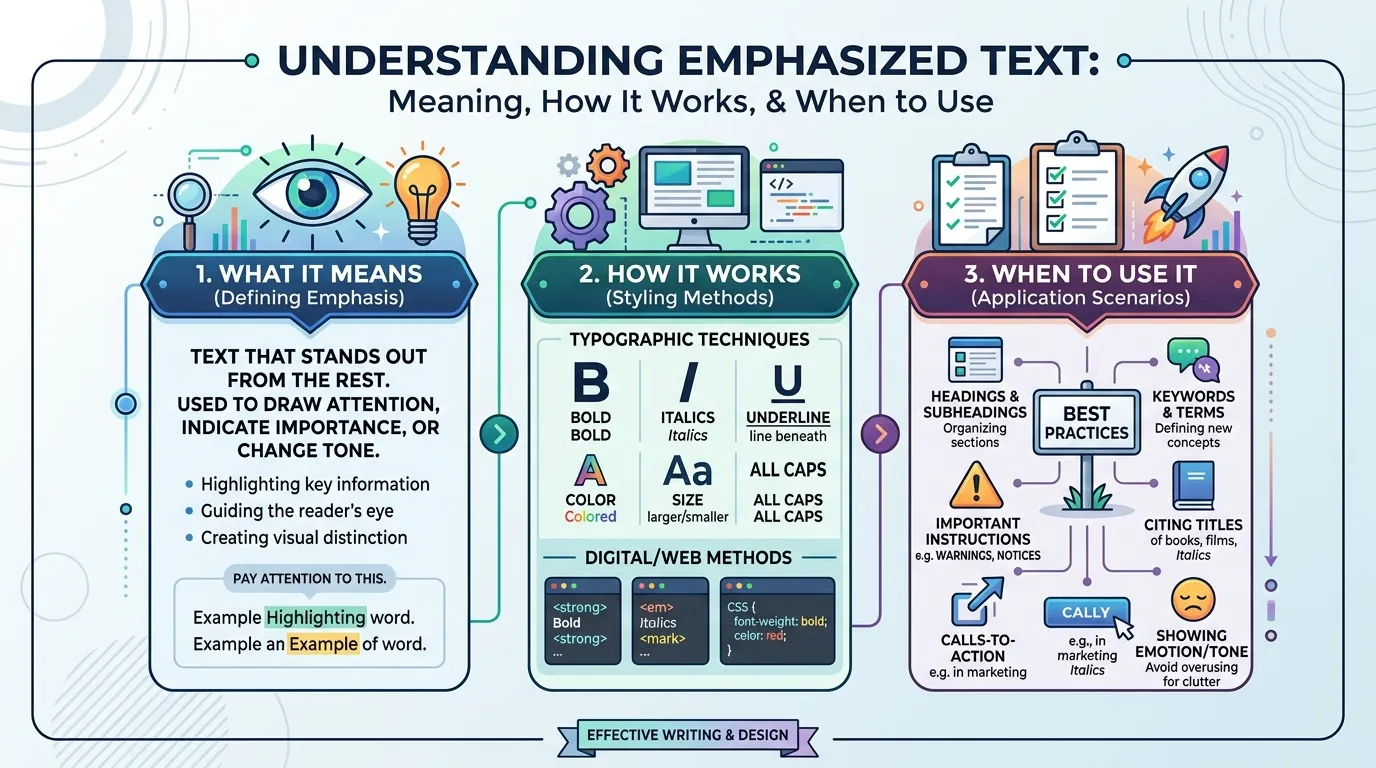
Emphasized text is text that has been visually or verbally highlighted to make it stand out from the surrounding content. It usually signals that a particular word, phrase, sentence, or idea deserves extra attention. Depending on the platform, emphasized text meaning can involve bold formatting, italics, underlining, capitalization, highlighting, or other visual cues.
You may see emphasized text in emails, text messages, social media posts, websites, documents, school assignments, advertisements, and online conversations. In digital communication, emphasis can do more than make words look different. It can communicate importance, urgency, emotion, contrast, correction, excitement, or even sarcasm.
For example, compare these two messages:
I said I would call you later.
and:
I said I would call you later.
The second version draws attention to the promise to call. The words have not changed, but their presentation changes how the reader processes the message.
Understanding what emphasized text means is especially useful in online communication because written messages do not include facial expressions, gestures, or vocal tone. Formatting often fills part of that gap.
This guide explains the meaning of emphasized text, why people use it, what different formatting styles communicate, how emphasis works across social media and messaging platforms, and how to use it effectively without creating confusion.
What Does Emphasized Text Mean?
Emphasized text means text that has been deliberately made more noticeable or important than the surrounding words.
The purpose is usually to direct the reader’s attention toward a specific idea.
Emphasis can communicate:
- Importance
- Urgency
- Strong emotion
- Contrast
- Clarification
- A correction
- A warning
- Excitement
- Sarcasm
- Personal preference
- A key point
The exact meaning depends heavily on context and formatting.
For example, bold text in an article usually means that the information is important. In a text message, however, bold words may feel more forceful or serious.
Consider:
Please send the document today.
versus:
Please send the document today.
The emphasized word suggests that the timing matters.
Similarly:
That was unexpected.
is different from:
That was VERY unexpected.
The second version carries more emotional weight.
Simple Definition of Emphasized Text
A simple way to understand the term is:
Emphasized text is writing that has been visually or stylistically changed to attract attention or give extra meaning to certain words.
It does not necessarily mean that the emphasized words are louder. Instead, they are made more prominent in some way.
Why Do People Emphasize Text?
People emphasize text because ordinary written language has limitations.
When you speak, you can change your voice to show what matters.
You can say:
“I didn’t say he stole it.”
Depending on which word you stress, the meaning can change:
- I didn’t say he stole it.
- I didn’t say he stole it.
- I didn’t say he stole it.
- I didn’t say he stole it.
- I didn’t say he stole it.
Written communication does not naturally provide those vocal changes.
Formatting helps compensate for that limitation.
Emphasis allows writers to guide readers toward the part of a sentence that carries the most significance.
This is particularly important in:
- Text messages
- Emails
- Social media
- Online discussions
- Digital marketing
- Blog posts
- Academic writing
- Business documents
- Instructions
- Presentations
- User interfaces
How Is Text Emphasized?
There are several common ways to emphasize words. Each method can create a slightly different effect.
Bold Text
Bold text is one of the clearest forms of emphasis.
It is commonly used for:
- Important information
- Key terms
- Warnings
- Headings
- Instructions
- Important dates
- Main ideas
Example:
Please remember to submit your application by Friday.
Bold formatting makes the selected information immediately visible.
In articles and websites, bold text is especially useful for helping readers scan content quickly.
Italic Text
Italic text often creates softer or more subtle emphasis.
It can communicate:
- Stress
- Nuance
- Personal reflection
- Titles
- Foreign words
- A change in tone
Example:
I really thought you understood.
The italicized word may suggest frustration or emotional emphasis.
Italics can feel less forceful than bold text, although the exact effect depends on context.
Underlined Text
Underlining traditionally indicates emphasis or importance.
For example:
Please read the underlined instructions carefully.
On websites, however, underlined text is frequently associated with hyperlinks. Because of this, excessive underlining can create confusion.
Capital Letters
Capitalization can produce strong emphasis.
For example:
I am SO excited!
or:
Please do NOT open this file.
All caps can communicate intensity, urgency, anger, excitement, or strong insistence.
However, using ALL CAPS for an entire message may feel like shouting.
Highlighting
Colored highlighting is often used in documents, study materials, presentations, and educational content.
For example, a student might highlight:
The exam will cover chapters 4–7.
The highlighting visually separates important information from supporting material.
Repetition
Sometimes writers emphasize a point without changing the formatting.
For example:
This is important. Really important.
Repeating a word or phrase creates emphasis through language rather than typography.
Punctuation
Punctuation can also add emphasis.
Compare:
You came.
with:
You came!
The exclamation mark increases emotional energy.
Similarly:
Really?
can communicate surprise, doubt, disbelief, or curiosity depending on context.
Emphasized Text Meaning in Text Messages
In texting, emphasized text meaning depends heavily on the relationship between the people and the surrounding conversation.
Because text messages do not include voice tone or facial expressions, people often use formatting to make their intended tone clearer.
For example:
I need you to come here.
may sound serious.
But:
I need you to come here.
places additional pressure on the word “need.”
A message such as:
That was interesting.
could be genuine, playful, skeptical, or sarcastic.
Context determines the interpretation.
What Does Bold Text Mean in a Text?
Bold text in a message generally indicates that the sender wants you to pay special attention to a particular word or phrase.
It can mean:
- “This is important.”
- “I really mean this.”
- “Pay attention to this.”
- “This is the part I want you to notice.”
- “I’m stressing this word.”
For example:
I said tomorrow, not today.
Here, bold emphasis highlights a correction.
Emphasized Text Meaning on Social Media
Social media platforms have made text emphasis part of everyday digital communication.
People use emphasis to make captions, comments, announcements, and posts more noticeable.
For example:
BIG NEWS! We’re moving!
The bold phrase immediately attracts attention.
On platforms where native bold or italic formatting is unavailable, users sometimes use:
- Capital letters
- Emojis
- Special Unicode characters
- Repetition
- Line breaks
- Punctuation
The goal is often to make the message visually stand out.
Emphasized Text on TikTok
On TikTok, emphasis often appears in captions, comments, video text overlays, and descriptions.
Creators may emphasize words to:
- Reveal a key point
- Build suspense
- Highlight a joke
- Direct viewers’ attention
- Create dramatic effect
- Emphasize a reaction
For example:
The ENDING changed everything.
Here, capitalization makes the final word more dramatic.
TikTok communication also relies heavily on visual storytelling, so emphasized words often work together with music, captions, editing, and facial expressions.
Emphasized Text on Instagram
Instagram users commonly emphasize text in captions, Stories, comments, and promotional content.
A business might write:
SALE ENDS TONIGHT
to communicate urgency.
A personal post might say:
I am so proud of this moment.
The emphasis adds emotional weight.
Instagram emphasis is often designed to make content easier to scan, especially when users are quickly scrolling through large amounts of content.
Emphasized Text on Snapchat
Snapchat communication tends to be casual and fast.
Emphasis can signal:
- Excitement
- Surprise
- Humor
- Urgency
- Frustration
For example:
COME NOW 😂
could be playful rather than genuinely urgent.
This demonstrates an important rule: formatting alone does not determine meaning.
The relationship, situation, punctuation, emojis, and previous messages all matter.
Emphasized Text on Discord
Discord users frequently communicate in communities, gaming groups, study servers, and professional communities.
Markdown-style formatting makes emphasis especially common.
Users may bold or italicize words to organize information.
For example:
Server meeting at 8 PM
or:
Please don’t spoil the new episode.
In Discord communities, bold formatting is often functional rather than emotional.
It helps users scan long messages quickly.
Emphasized Text on Reddit
Reddit uses formatting to help users structure discussions.
Bold and italic text may be used to:
- Highlight arguments
- Add context
- Emphasize opinions
- Organize explanations
- Draw attention to important details
For example:
The main problem is not the price. It’s the quality.
The bold statement tells readers where the writer believes the central issue lies.
Reddit users may also use capitalization or punctuation for emotional emphasis, especially in casual discussions.
Emphasized Text in Gaming
Gamers use emphasis to communicate quickly during fast-moving conversations.
Examples include:
RUN!
BOSS INCOMING
Do not open that door.
In gaming environments, emphasis can communicate immediate danger or instructions.
In competitive games, all caps can also express excitement or frustration:
THAT WAS INSANE!
The same formatting that looks aggressive in a workplace email can feel completely normal among gaming friends.
Emphasized Text in Dating and Relationships
Text emphasis can become especially meaningful in romantic conversations.
Consider:
I miss you.
versus:
I miss you.
The second message may communicate stronger emotion.
Likewise:
I really like you.
can indicate that the sender wants to strengthen the emotional meaning.
However, emphasized text should not automatically be interpreted as romantic or flirtatious.
A person may emphasize words simply because they want to avoid misunderstanding.
Can Emphasis Change the Tone of a Message?
Yes.
Consider:
That’s fine.
Depending on the conversation, this could sound neutral.
Now consider:
That’s fine.
The emphasis might suggest that the person is trying to convince you—or that they are not actually fine.
This is why interpreting emphasis requires context.
Emphasized Text in Workplace Communication
In professional communication, emphasis is usually more restrained.
It can be useful for highlighting:
- Deadlines
- Required actions
- Important changes
- Meeting details
- Deliverables
- Warnings
- Key decisions
For example:
Please submit the report by 5 PM Friday.
This is clear and professional.
However:
YOU MUST SUBMIT THIS NOW
can sound aggressive unless the situation genuinely requires urgent action.
Best Practices for Professional Emphasis
Use emphasis when it improves clarity.
Good examples include:
- Deadline: August 15
- Action required
- Please review the final section.
- The meeting has been moved to Monday.
Avoid making every word bold or capitalized.
When everything is emphasized, nothing feels especially important.
Emphasized Text vs Bold Text
These terms are related, but they are not identical.
Emphasis describes the purpose: making something stand out.
Bold text describes one specific formatting method used to create emphasis.
Think of it this way:
| Term | Meaning |
|---|---|
| Emphasis | Making an idea stand out |
| Bold | Thick text formatting |
| Italics | Slanted text formatting |
| Underline | A line beneath text |
| All caps | Capital letters used for visual intensity |
| Highlighting | Adding visual background emphasis |
Bold is therefore one form of emphasized text, but emphasized text can take many forms.
Emphasized Text vs Italic Text
Italics are often used for subtle emphasis.
For example:
I did tell you.
The italics emphasize “did” without making the statement visually overwhelming.
Bold generally produces stronger visual emphasis:
I did tell you.
Neither approach is universally stronger in conversation. The effect depends on the platform and context.
Common Reasons Someone Emphasizes a Word
When someone emphasizes a particular word, ask what role that word plays in the sentence.
It may indicate:
1. Correction
I said Tuesday, not Thursday.
2. Importance
This is very important.
3. Emotion
I’m so happy for you!
4. Urgency
Please respond today.
5. Contrast
I wanted the blue one, not the green one.
6. Sarcasm
That was brilliant.
The emphasis may signal that the writer means the opposite of the literal statement.
7. Humor
I am definitely making a healthy choice with this pizza.
Here, emphasis can reinforce the joke.
Real-Life Examples of Emphasized Text
Here are several realistic examples.
Example 1: Friends
Friend A: Are you coming tonight?
Friend B: Yes, I’ll definitely be there.
The emphasis strengthens the assurance.
Example 2: Workplace
Manager: Please send the final document by 3 PM.
The emphasis highlights the deadline.
Example 3: Dating
Person A: Do you actually like me?
Person B: I really like you.
The emphasis strengthens the emotional message.
Example 4: Family
Parent: Please remember to lock the door.
The emphasis communicates importance.
Example 5: Gaming
Player: BOSS IS HERE!
The capitalization creates urgency.
Example 6: Social Media
I FINALLY DID IT!
The capitalization communicates excitement.
Does Emphasized Text Always Mean Anger?
No.
This is one of the most common misunderstandings.
Emphasis can communicate many emotions, including:
- Happiness
- Excitement
- Love
- Surprise
- Concern
- Urgency
- Frustration
- Anger
- Humor
For example:
I GOT THE JOB!!!
is clearly enthusiastic.
But:
STOP DOING THAT.
is much more likely to sound angry or forceful.
The surrounding words and punctuation help determine the tone.
Can Emphasized Text Be Sarcastic?
Yes.
Sarcasm is one of the more difficult uses of emphasis because written communication lacks vocal tone.
For example:
Wow, you’re really early.
If the person arrived late, italicizing “really” could emphasize the sarcasm.
Another example:
That was such a great idea.
Depending on the situation, the bold text could communicate genuine praise or sarcastic criticism.
This is why readers should consider the entire conversation rather than interpreting formatting in isolation.
Common Misconceptions About Emphasized Text
Misconception 1: Bold Always Means Anger
It does not.
Bold text is often simply used to highlight information.
Misconception 2: Italics Always Mean Sarcasm
Not necessarily.
Italics can indicate stress, titles, foreign terms, thoughts, or subtle emphasis.
Misconception 3: All Caps Always Means Someone Is Yelling
All caps can feel like yelling, but it can also communicate excitement, urgency, humor, or dramatic emphasis.
Misconception 4: Emphasis Has One Universal Meaning
It does not.
The meaning changes according to the platform, relationship, culture, and context.
Misconception 5: Every Formatting Choice Has a Hidden Message
Sometimes bold or italic text is simply used for readability.
A writer may emphasize a word because they want readers to find information quickly—not because they are trying to communicate an emotional subtext.
How to Interpret Emphasized Text Correctly
When someone sends you emphasized text, use a few clues.
Look at the Specific Word
Ask why that particular word was emphasized.
Read the Entire Sentence
Never interpret the emphasized word alone.
Consider the Previous Messages
Earlier messages may explain the intended meaning.
Consider Your Relationship
A bold message from your boss may have a different tone from the same message sent by a close friend.
Look at Punctuation and Emojis
For example:
WHAT?! 😂
is very different from:
WHAT.
The first could be playful or shocked. The second feels more serious.
Consider the Platform
A bold heading in Discord may simply organize information.
The same formatting in a personal text might carry more emotional weight.
How to Use Emphasized Text Effectively
If you are the person writing the message, emphasis should have a purpose.
Use It to Improve Clarity
Highlight information readers should not miss.
Use It Sparingly
Too much emphasis reduces its impact.
Match the Platform
Professional emails require more restraint than casual social media posts.
Avoid Unnecessary All Caps
Capital letters can make a message feel aggressive.
Emphasize the Most Important Word
Instead of emphasizing an entire sentence, identify the word that carries the key meaning.
For example:
Please send the document tomorrow.
is cleaner than:
PLEASE SEND THE DOCUMENT TOMORROW.
Think About How the Message Could Be Misread
Before sending an emphasized message, consider whether the reader could interpret it as angry, sarcastic, demanding, or passive-aggressive.
Summary Table: Emphasized Text Meaning at a Glance
| Key Fact | Explanation |
|---|---|
| Meaning | Text made more noticeable or significant |
| Main purpose | To attract attention or add emphasis |
| Common formats | Bold, italics, underline, caps, highlighting |
| Common settings | Texting, email, social media, websites, documents |
| Tone | Can be neutral, emotional, urgent, playful, or serious |
| Popularity | Extremely common in digital communication |
| Most important factor | Context |
| Related terms | Bold text, text emphasis, highlighted text, stressed words |
| Potential misunderstanding | Emphasis can sometimes look angry or sarcastic |
| Best practice | Use emphasis selectively and intentionally |
The Evolution of Text Emphasis
Text emphasis is not a new concept.
Long before smartphones and social media, writers used typography and punctuation to guide readers.
Printed books used techniques such as:
- Italics
- Bold type
- Capital letters
- Spacing
- Headings
- Underlining
Digital communication expanded these possibilities.
As people moved from letters and printed documents to emails, instant messaging, forums, and social media, text formatting became a way to compensate for the absence of physical communication cues.
Today, emphasis is deeply integrated into digital language.
It is not simply a design feature. It has become part of how people communicate tone and intent.
Why Context Matters More Than Formatting
One of the biggest lessons about emphasized text meaning is that formatting should never be interpreted independently.
Suppose someone writes:
Fine.
That could mean:
- Genuine agreement
- Frustration
- Sarcasm
- Reluctance
- Anger
- Humor
Now imagine a friend writes:
FINE 😂😂
The emojis completely change the likely interpretation.
Likewise:
Thank you so much!
is usually positive.
Therefore, the surrounding context provides the meaning that formatting alone cannot provide.
Emphasized Text and Accessibility
Good emphasis should also consider readability and accessibility.
If a message contains important information, relying only on color may not be enough because some readers may have difficulty distinguishing certain colors.
Likewise, excessive capitalization can make content harder to read.
Effective digital communication combines emphasis with clear wording.
Instead of:
IMPORTANT IMPORTANT IMPORTANT
write:
Important: Your appointment has moved to Monday.
The second version is clearer, more useful, and easier to understand.
Frequently Asked Questions
What does emphasized text mean in a message?
Emphasized text means that the sender has made a word or phrase stand out to show that it deserves extra attention. Depending on the context, it may communicate importance, emotion, urgency, correction, excitement, or contrast.
Does emphasized text mean the person is angry?
Not necessarily. Emphasis can communicate anger, but it can also show excitement, affection, urgency, humor, or importance. The surrounding conversation is essential for understanding the intended tone.
What does bold text mean when texting?
Bold text usually means the sender wants you to pay particular attention to the bolded words. It may highlight an important detail, clarify a statement, strengthen an emotion, or correct something that was previously misunderstood.
Is emphasized text the same as bold text?
No. Bold text is one method of creating emphasis. Emphasis can also be created through italics, underlining, capitalization, highlighting, punctuation, repetition, or other formatting techniques.
Why do people use all caps for emphasis?
All caps makes text visually prominent and can communicate strong emotion, excitement, urgency, surprise, or anger. In casual digital communication, excessive all caps can also be interpreted as shouting.
Can emphasized text be sarcastic?
Yes. Emphasis can make sarcasm easier to communicate in writing. For example, emphasizing a word such as really or great may signal that the writer’s literal words should not be taken at face value.
What does italicized text mean in a text?
Italicized text often indicates subtle emphasis, emotional stress, a thought, a title, or a particular word that the writer wants readers to notice. In casual texting, its meaning depends on the surrounding conversation.
Why is text emphasis important online?
Online communication lacks many vocal and physical cues found in face-to-face conversations. Text emphasis helps writers communicate importance, tone, emotion, urgency, and contrast more clearly.
How can I emphasize text without sounding rude?
Use emphasis sparingly and focus on the specific information that matters. Bold a deadline or key phrase rather than writing an entire message in capital letters. Clear wording also reduces the chance of sounding aggressive.
Can emphasized text have different meanings on different platforms?
Yes. A bold heading on a website may simply improve readability, while bold text in a personal conversation may carry emotional meaning. Platform conventions, relationships, and context all influence interpretation.
Final Takeaway
Emphasized text means that a writer has deliberately made certain words or phrases stand out to give them extra attention, importance, or emotional weight. It can appear as bold text, italics, underlining, capitalization, highlighting, punctuation, or other forms of visual emphasis.
The meaning is not always emotional. Sometimes emphasis is simply a practical way to make information easier to find. In other situations, it can communicate excitement, urgency, frustration, affection, sarcasm, correction, or strong personal feeling.
The most important factor is context.
If you see emphasized text in a text message, Instagram caption, TikTok comment, Discord conversation, Reddit post, email, or workplace message, look at the words around it, the previous conversation, the relationship between the people, and the platform’s normal communication style.
When used well, emphasis makes writing clearer and more expressive. When overused, it can make messages feel aggressive, confusing, or unnecessarily dramatic.
In short, emphasized text is a tool for directing attention and adding meaning to written communication. Understanding how it works can help you interpret messages more accurately—and use your own words more effectively.