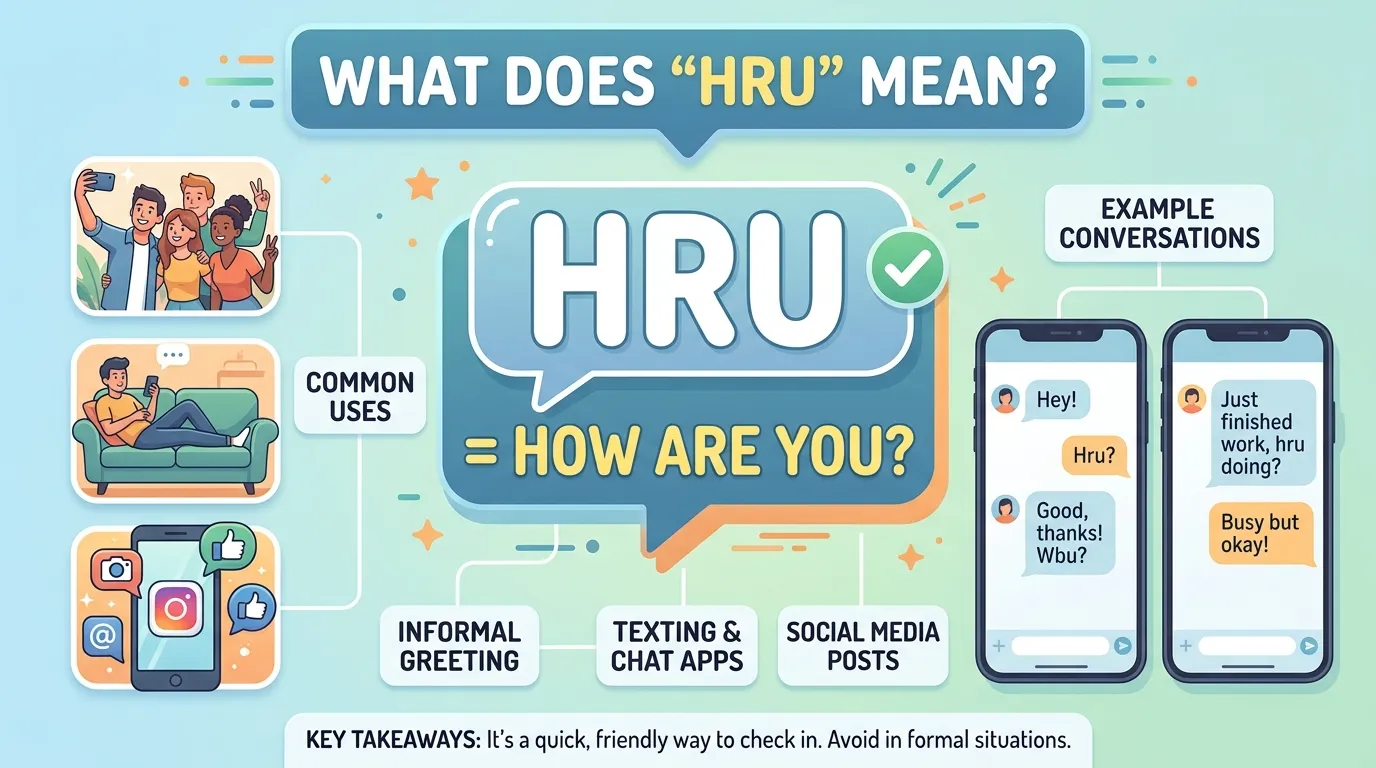
If someone sends you “HRU?” in a text message, they are usually asking a very simple question: “How are you?” It is a common texting abbreviation used to check on someone’s mood, feelings, or general well-being without typing the full phrase.
The HRU meaning in a text is straightforward, but the tone can change depending on who sends it, your relationship with that person, and the conversation around it. A friend may use “HRU?” casually, while someone you are dating may use it as a way to start a conversation. On platforms such as Instagram, Snapchat, TikTok, Discord, Reddit, and messaging apps, HRU can help people communicate quickly and casually.
Understanding what HRU means in texting is useful because abbreviations often carry subtle social meanings. “HRU?” can sound friendly, caring, playful, flirty, or simply conversational. In some situations, it may even be a polite way to restart a conversation after a period of silence.
In this guide, you’ll learn the HRU meaning, how people use it, where it came from, what it means in different contexts, how to respond, and how it compares with similar expressions such as HBU, WYD, HYD, and HOW ARE U.
What Does HRU Mean in a Text?
HRU means “How are you?” in a text message.
It is an informal abbreviation created by shortening the words:
- H = How
- R = are
- U = you
So:
HRU? = How are you?
The phrase is generally used as a quick way to ask about someone’s well-being or invite them to continue a conversation.
Quick example
Person A: HRU?
Person B: I’m good! Just relaxing. HBU?
Here, HRU simply means “How are you?”
It is especially common in casual digital communication where people want to type quickly or keep their messages short.
HRU Meaning in Texting at a Glance
| Feature | Meaning |
|---|---|
| HRU meaning | How are you? |
| Type | Texting abbreviation |
| Main purpose | Asking about someone’s well-being |
| Tone | Casual, friendly, informal |
| Common contexts | Texting, social media, DMs, chats |
| Formality | Very informal |
| Common response | “I’m good, hbu?” |
| Similar terms | HBU, HYD, How are you?, How you doing? |
| Usually positive? | Yes |
| Can be flirty? | Yes, depending on context |
| Can be caring? | Yes |
| Best used with | Friends, peers, casual contacts |
Why Do People Say HRU Instead of “How Are You?”
The main reason is speed and convenience.
Text messaging encouraged people to develop shorter ways of communicating. When character limits, tiny phone keyboards, and rapid conversations were common, abbreviations made messages faster to type.
Instead of writing:
How are you?
Someone could simply write:
HRU?
The abbreviation also fits the informal nature of online communication. People often use shortened expressions because they sound more relaxed and conversational.
Other examples include:
- LOL = Laughing out loud
- BRB = Be right back
- BTW = By the way
- IDK = I don’t know
- HBU = How about you?
- WYD = What are you doing?
- TY = Thank you
- OMG = Oh my God
HRU belongs to this broader tradition of internet slang and texting shorthand.
The Origin and History of HRU
There is no widely recognized individual who invented HRU. Like many texting abbreviations, it developed organically through informal digital communication.
Its roots are connected to the early culture of SMS texting, online chat rooms, instant messaging, and internet slang.
Before smartphones became dominant, people frequently looked for ways to reduce typing. Abbreviations such as “u” for “you,” “r” for “are,” and “2” for “to” became especially common.
This produced expressions such as:
- HRU? — How are you?
- HBU? — How about you?
- RU OK? — Are you okay?
- WBU? — What about you?
- R U there? — Are you there?
As smartphones and social media became mainstream, many abbreviations remained in use even though people no longer needed to save every character.
Today, HRU is less about saving characters and more about casual digital style.
Someone may have plenty of time to type “How are you?” but still choose “HRU?” because it feels informal and natural.
What Does HRU Mean in Different Contexts?
Although the literal meaning remains “How are you?”, its implied meaning can change depending on the situation.
HRU Between Friends
Among friends, HRU is usually a casual check-in.
Example:
Hey! HRU? Haven’t talked to you in forever.
This can communicate:
“How have you been?”
The sender may genuinely want an update on your life.
HRU From Someone You Like
If someone you’re interested in sends “HRU?”, it can simply be a conversation starter. However, context can make it feel slightly flirtatious.
For example:
Hey 😊 HRU?
The emoji and timing may make the message feel warmer than a plain “HRU?”
But HRU itself is not inherently romantic or sexual.
You should look at the rest of the conversation before deciding whether someone is flirting.
HRU in Dating
In dating conversations, HRU can be a low-pressure opener.
For example:
HRU today?
Pretty good! What are you up to?
Someone may use it to reconnect after a date or start chatting without needing a specific topic.
If the person repeatedly checks in with you, asks follow-up questions, and keeps the conversation going, the message may indicate genuine interest.
HRU on Instagram
On Instagram, HRU is most likely to appear in:
- Direct messages
- Story replies
- Casual conversations
- Comments between close friends
For example:
Saw your story! HRU?
Here, the person may be checking on you while using your story as a natural conversation opener.
HRU on Snapchat
Snapchat communication tends to be casual and abbreviated, so HRU fits naturally.
A Snapchat conversation might look like:
HRU?
Good lol, hbu?
I’m chillin.
The abbreviation helps maintain the quick, informal style common to messaging.
HRU on TikTok
On TikTok, HRU may appear in DMs or comments, especially among users who already know each other.
For example:
Your video was hilarious 😂 HRU?
In this situation, HRU means “How are you?” while also providing a way to begin a personal conversation.
HRU on Discord
On Discord, HRU can be used in private messages, gaming communities, or casual group conversations.
Example:
Yo, HRU? You hopping on later?
Here, HRU may be less about a serious health check and more about casually asking how someone is doing.
HRU in Gaming
Gamers often use extremely short messages because conversations happen quickly.
Example:
HRU bro?
Good. You playing tonight?
The abbreviation can function almost like saying:
“Hey, how are you doing?”
HRU on Reddit
On Reddit, HRU is less universal than on private messaging platforms because Reddit discussions are often topic-focused. However, you may still see it in casual comments, direct messages, or communities where users know each other.
Its meaning remains the same: “How are you?”
Is HRU a Slang Word or an Acronym?
HRU is best described as a texting abbreviation or initialism rather than traditional slang.
Traditional slang may involve words whose meanings differ significantly from standard English.
For example:
- “Ghosting”
- “Savage”
- “Cringe”
- “Flex”
- “Low-key”
HRU, however, is simply a shortened version of an ordinary question.
It belongs to the larger category of text abbreviations, chat shorthand, and internet language.
Is HRU Formal or Informal?
HRU is highly informal.
You should generally use it with:
- Friends
- Family members you text casually
- Classmates
- Gaming friends
- Online friends
- Romantic interests
- Close coworkers, depending on workplace culture
You should avoid it in formal communication such as:
- Business emails
- Job applications
- Cover letters
- Academic papers
- Official customer-service messages
- Professional correspondence
Instead of:
HRU?
Use:
How are you?
or:
How are you doing?
in professional situations.
Does HRU Sound Rude?
Usually, no.
HRU is normally neutral or friendly. However, because it is extremely short, its emotional tone can sometimes seem distant.
Compare:
HRU?
with:
Hey! How are you doing? 😊
The second message feels warmer because it contains more words and emotional cues.
A person who sends “HRU?” is not necessarily being cold. They may simply prefer concise texting.
When HRU could seem cold
If someone responds to a long emotional message with:
HRU
it could feel inappropriate or dismissive because the context calls for more empathy.
Tone depends heavily on the surrounding conversation.
Is HRU a Caring Expression?
It can be.
When someone asks “HRU?”, they are showing at least some level of interest in how you are doing.
For example:
Hey, I heard you had a rough day. HRU?
Here, HRU clearly functions as a check-in.
However, the abbreviation itself does not prove deep concern. The meaning comes from the situation and the sender’s behavior.
A more caring message might be:
Hey, I know today was difficult. How are you feeling now?
Can HRU Be Flirty?
Yes, HRU can be used flirtatiously, but it is not automatically flirty.
Context matters.
Casual
HRU?
Meaning:
How are you?
Friendly
Heyyy HRU? Haven’t heard from you today.
Meaning:
How have you been?
Potentially flirty
HRU handsome? 😉
Here, “HRU” itself is still “How are you?” The flirtation comes from “handsome,” the emoji, and the overall context.
Another example:
HRU? I was thinking about you.
That message has a more romantic undertone than a simple “HRU?”
How Should You Respond to HRU?
The easiest response is to answer the question and optionally ask the person the same thing.
Simple responses
- “I’m good, hbu?”
- “Doing great! You?”
- “I’m okay. How are you?”
- “Pretty good, thanks!”
- “I’m doing well. What about you?”
Casual responses
If you’re talking with a close friend:
Good lol, just chilling. HBU?
Or:
I’m alright 😂 What are you up to?
If you’re having a bad day
You don’t have to pretend everything is fine.
You could say:
Honestly, not great today. But I’ll be okay.
Or:
A little stressed, but I’m managing. How about you?
If you want to continue the conversation
Don’t stop at:
Good.
Instead, add something that gives the other person something to respond to:
I’m good! Just finished work. How’s your day going?
This naturally keeps the conversation moving.
HRU vs. HBU: What’s the Difference?
These two abbreviations are often used together.
HRU = How are you?
HBU = How about you?
Example:
A: HRU?
B: I’m good! HBU?
A: I’m doing pretty well.
The first person asks about the other person’s condition.
The second person returns the question.
Easy way to remember
HRU asks:
How are you?
HBU asks:
How about you?
They are complementary expressions.
HRU vs. HYD
Another abbreviation you may encounter is HYD.
Depending on the community, HYD commonly means:
“How you doing?”
It has almost the same practical meaning as HRU.
| Abbreviation | Meaning | Tone |
|---|---|---|
| HRU | How are you? | Casual |
| HYD | How you doing? | Casual |
| HBU | How about you? | Casual |
| WYD | What are you doing? | Casual |
| WBU | What about you? | Casual |
| RU OK? | Are you okay? | More concerned |
The best choice depends on the conversation.
HRU vs. WYD
These abbreviations are sometimes confused because both can start a conversation.
But they ask different questions.
HRU? means:
How are you?
WYD? means:
What are you doing?
For example:
HRU?
I’m good.
versus:
WYD?
Just watching Netflix.
Someone can ask both:
HRU? WYD tonight?
That means:
How are you? What are you doing tonight?
Common Mistakes When Using HRU
Although HRU is simple, a few mistakes can make the conversation awkward.
Using HRU in formal writing
Avoid:
HRU, Professor?
Use:
How are you, Professor?
Assuming HRU is romantic
An HRU message doesn’t automatically mean someone likes you romantically.
Look for additional signals such as:
- Flirty language
- Compliments
- Frequent personal messages
- Romantic emojis
- Attempts to spend time together
- Consistent interest in your life
Giving a one-word response
If you want to continue the conversation, avoid:
Good.
Instead try:
I’m good! Just relaxing. HBU?
Overanalyzing punctuation
“HRU?” and “hru?” usually have the same basic meaning.
Capitalization does not automatically indicate a different emotional message.
Does Capitalization Change the Meaning of HRU?
Usually, no.
You might see:
- HRU?
- hru?
- Hru?
- hRU?
All generally mean:
“How are you?”
The difference is mostly stylistic.
Lowercase abbreviations often feel more relaxed, while uppercase letters can appear slightly more deliberate. But you shouldn’t assume that capitalization carries a hidden meaning.
HRU in Everyday Digital Communication
The abbreviation can serve several conversational purposes.
As a greeting
Hey! HRU?
As a check-in
HRU after yesterday?
As a conversation starter
HRU? What have you been up to?
After a period of silence
Hey stranger, HRU?
After hearing someone had a problem
HRU now?
In a romantic conversation
Morning 😊 HRU?
The basic meaning stays the same, but the social purpose changes according to context.
Positive and Negative Connotations of HRU
Positive connotations
HRU can suggest:
- Friendliness
- Interest
- Concern
- Openness
- Casual connection
- A desire to talk
Potentially negative interpretations
In certain situations, it may seem:
- Too brief
- Impersonal
- Lazy
- Emotionally distant
- Generic
For example, if someone repeatedly sends only:
HRU?
without ever engaging with your answers, you might feel that they are making minimal effort.
But that doesn’t mean HRU itself is negative.
Why Text Abbreviations Are Still Popular
Digital communication rewards speed, simplicity, and informality.
Even though modern smartphones offer excellent keyboards and predictive text, abbreviations remain part of internet culture.
People also use them to signal familiarity.
Compare:
How are you?
with:
hru
The second feels more like casual online conversation.
Texting language also changes continuously. Some abbreviations become outdated, while others remain popular for years.
The continued use of expressions such as LOL, IDK, BTW, HBU, and HRU shows that digital shorthand has become an established part of informal English.
How HRU Fits Into Modern Social Media Language
Social platforms have blurred the boundaries between spoken and written language.
People increasingly write messages the way they speak.
That is why expressions such as:
- “How r u?”
- “hru?”
- “wyd?”
- “lol”
- “ikr”
- “tbh”
- “ngl”
can feel natural in digital conversations.
On platforms with fast-moving chats, short expressions also make communication easier.
However, slang changes quickly. Younger users may prefer newer expressions, while older abbreviations can feel more traditional or “classic internet.”
HRU remains understandable because the phrase behind it is extremely common.
Real-Life Conversation Examples
Example 1: Friends reconnecting
Alex: Hey! HRU?
Sam: I’m good! Been super busy lately. HBU?
Alex: Same here. We should catch up sometime.
Meaning: Alex is casually checking on Sam and reopening the friendship conversation.
Example 2: Dating
Jordan: Hey 😊 HRU?
Taylor: I’m good! Just got home. You?
Jordan: Doing good. How was your day?
Meaning: HRU is being used as a friendly conversation opener. The emoji and continued conversation may make it feel warmer.
Example 3: Checking on someone
Mia: HRU after the appointment?
Chris: Much better, thanks for asking.
Meaning: Here, HRU functions as a genuine check-in.
Example 4: Discord
A: Yo, HRU?
B: Good bro. You getting on tonight?
A: Probably around 9.
Meaning: HRU is casual gaming-community language.
Example 5: Instagram DM
A: Your vacation photos look amazing! HRU?
B: I’m great! Having such a good time.
Meaning: HRU transitions from commenting on a post to a personal conversation.
Is HRU Still Used Today?
Yes. HRU is still understandable and used in informal digital communication, particularly in texting, direct messages, and casual online chats.
However, frequency varies by age group, platform, community, and personal texting style.
Some people prefer:
How are you?
Others use:
hru?
And many people choose:
How are you doing?
There is no single correct form for casual communication.
Should You Use HRU?
Use HRU when the conversation is informal and the other person is likely to understand texting abbreviations.
It’s appropriate when:
- You’re texting a friend.
- You’re messaging someone casually.
- You’re chatting online.
- You’re talking to someone you’re dating.
- You’re communicating in a gaming community.
- You’re sending a casual social-media DM.
Avoid it when:
- Writing a professional email.
- Contacting a potential employer.
- Writing to a professor or official.
- Sending a formal business message.
- Communicating in an important professional situation.
When in doubt, spell it out.
Frequently Asked Questions About HRU Meaning in a Text
What does HRU stand for in texting?
HRU stands for “How are you?” It is an informal texting abbreviation made by using the first letters or shortened forms of the words in the phrase.
What does HRU mean from a girl?
If a girl texts you “HRU?”, it normally means “How are you?” The message does not automatically indicate romantic interest. Its meaning may become flirty when combined with compliments, affectionate emojis, romantic language, or other signs of interest.
What does HRU mean from a guy?
If a guy sends “HRU?”, he is generally asking how you’re doing. It could be friendly, casual, caring, or potentially flirtatious depending on the conversation. The abbreviation alone doesn’t establish romantic intent.
What is the best response to HRU?
A natural response is:
“I’m good, hbu?”
You can also answer honestly and add another question if you want to keep the conversation going.
Is HRU rude?
No, HRU is not inherently rude. It is simply informal and brief. However, it may feel impersonal in a serious conversation where a more thoughtful response would be appropriate.
Is HRU the same as “How are you doing?”
Yes, in most casual conversations, HRU and “How are you doing?” serve essentially the same purpose. Both ask about someone’s general well-being.
What is the difference between HRU and HBU?
HRU means “How are you?”, while HBU means “How about you?”
They are often used together:
HRU?
I’m good! HBU?
Can HRU be used professionally?
It is better to avoid HRU in formal professional communication. Use “How are you?”, “How are you doing?”, or another complete phrase instead.
Does HRU mean “How are you?” on Snapchat and Instagram?
Yes. On Snapchat, Instagram, and similar social platforms, HRU generally means “How are you?” The platform does not change its basic meaning.
Is HRU still popular slang?
HRU remains recognizable and usable as informal internet shorthand. Its popularity can vary by age, platform, and online community, but most people familiar with texting abbreviations can understand it.
Final Takeaway: HRU Meaning in a Text
The HRU meaning in a text is simple: “How are you?”
It is an informal texting abbreviation used to check on someone, start a conversation, reconnect with a friend, or show casual interest. You may encounter HRU in text messages, Instagram DMs, Snapchat conversations, TikTok messages, Discord chats, gaming communities, and other informal digital spaces.
The important thing is that HRU does not have a hidden meaning by itself. It can be friendly, caring, casual, or even mildly flirtatious depending on the surrounding conversation.
Remember these key points:
- HRU = How are you?
- It is a casual texting abbreviation.
- It is generally friendly and informal.
- It can be used as a conversation starter.
- It may be flirtatious when the surrounding context suggests romantic interest.
- HBU = How about you?, while HRU asks how someone is doing.
- It is appropriate for casual conversations but not ideal for formal professional writing.
- The best response is usually a short answer followed by “HBU?” or “How about you?”
So, if someone sends you “HRU?”, you don’t need to decode a complicated piece of internet slang. They are simply asking: “How are you?”