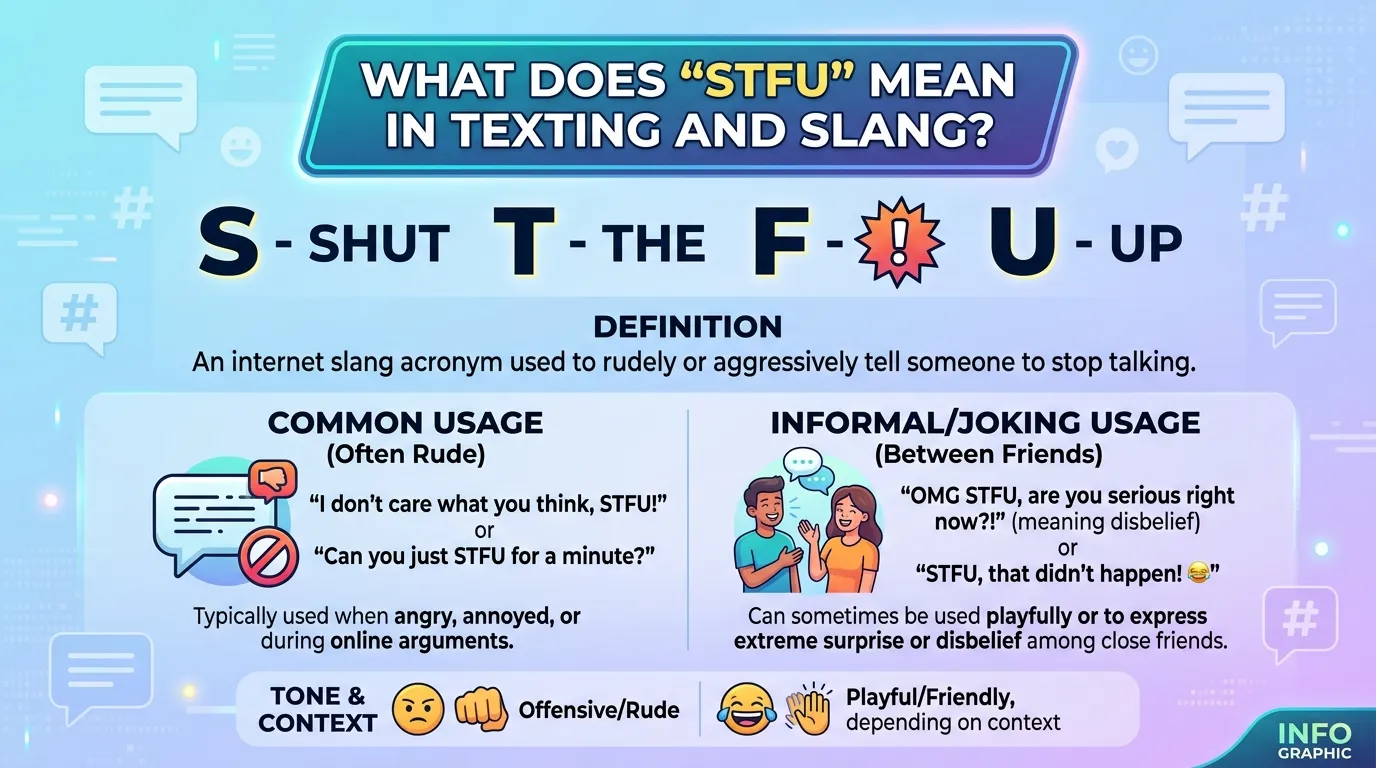
sSTFU stands for “shut the f* up.”** It is a vulgar abbreviation commonly used in texting, social media, online chats, gaming, and casual conversations.
The phrase usually tells someone to stop talking or be quiet, but its emotional meaning can change depending on the situation. Someone might use STFU seriously during an argument, while another person might use it jokingly with a close friend.
For example:
Friend 1: “I just won two concert tickets!”
Friend 2: “STFU!! No way!”
Here, the person probably is not literally demanding silence. Instead, STFU expresses shock, excitement, or disbelief.
Compare that with:
Person 1: “You are completely wrong about this.”
Person 2: “STFU and leave me alone.”
In this situation, STFU is clearly hostile.
Because it contains profanity, STFU is considered an informal and potentially offensive slang term. It is generally unsuitable for professional emails, formal conversations, customer service messages, or communication with people you do not know well.
STFU Meaning in Text at a Glance
| Term | Meaning | Tone | Common Places |
|---|---|---|---|
| STFU | Shut the f*** up | Rude, humorous, shocked, or aggressive | Texting, social media, gaming |
| STFU! | Shut the f*** up! | Stronger and more emotional | Arguments, reactions |
| stfu | Same meaning | Often more casual | Texts, DMs, chats |
| STFU 😂 | Usually joking or shocked | Playful | Friends and social media |
| STFU rn | Shut the f*** up right now | Forceful | Arguments or teasing |
| Please STFU | Please be quiet | Blunt and rude | Informal conversations |
What Does STFU Stand For?
STFU stands for “shut the f* up.”**
The phrase is built from the first letters of the words:
- S = Shut
- T = The
- F = F***
- U = Up
The abbreviation became popular because internet users could communicate a strong reaction quickly without typing the entire phrase.
The profanity is usually represented by the letter F, although people may spell out the complete phrase in casual online conversations.
Because the expression is vulgar, the abbreviation is often preferred when someone wants to communicate the same idea quickly or somewhat indirectly.
What Does STFU Mean in a Text Message?
In a text message, STFU usually means “shut the f* up,”** but the intended meaning depends on the relationship between the people and the surrounding conversation.
There are several common interpretations.
STFU Can Literally Mean “Be Quiet”
The most direct meaning is a demand for silence.
For example:
“STFU. I’m trying to study.”
Here, the sender is genuinely telling the other person to stop talking or making noise.
This use is usually confrontational and can easily offend the recipient.
STFU Can Express Surprise
People also use STFU when they hear something shocking or difficult to believe.
For example:
“I met Taylor Swift yesterday.”
“STFU! Seriously?”
The second person may not actually want the first person to stop talking. Instead, STFU communicates something like:
“No way!”
“Are you serious?”
“I can’t believe that!”
This is one of the most important contextual differences to understand.
STFU Can Express Excitement
Among close friends, STFU can sometimes show enthusiastic disbelief.
“I got accepted into my dream college!”
“STFU 😭 I’m so happy for you!”
The expression may sound aggressive when read literally, but the emotional context makes it playful.
STFU Can Be Used as a Joke
Friends sometimes use exaggerated insults as part of their normal humor.
“I just ate an entire pizza by myself.”
“STFU 😂”
The speaker may be teasing rather than genuinely angry.
Still, this type of humor depends on the relationship. What sounds funny between close friends can sound insulting when used with someone you barely know.
Why Does STFU Have Different Meanings?
Text communication removes many signals that normally help us understand someone’s intention.
When someone speaks face-to-face, you can hear:
- Their voice
- Their volume
- Their tone
- Their laughter
- Their hesitation
- Their facial expression
- Their body language
A text such as “STFU” does not provide those signals.
That is why context matters so much.
Compare:
“STFU 😂😂”
with:
“STFU.”
The first may be playful. The second may indicate anger.
Likewise:
“STFU OMG 😭”
could mean:
“I can’t believe what you just told me!”
The same abbreviation can therefore communicate completely different emotions.
Is STFU Rude?
Yes, STFU is generally considered rude or vulgar.
The phrase contains profanity and literally tells another person to shut up. In many situations, it can sound disrespectful, hostile, or aggressive.
However, the level of offensiveness depends on context.
When STFU Is More Likely to Be Playful
It may be playful when:
- Close friends use it with each other
- The conversation is already humorous
- Emojis indicate laughter or excitement
- The sender is reacting to surprising news
- Both people commonly use profanity
- There is no ongoing disagreement
When STFU Is More Likely to Be Offensive
It is more likely to be genuinely rude when:
- It appears during an argument
- The sender is criticizing you
- There are no playful cues
- The relationship is distant
- It is directed at a coworker or manager
- It is used repeatedly to silence someone
- The sender is clearly angry
When in doubt, interpret STFU cautiously rather than assuming it is a joke.
STFU Meaning on Social Media
The meaning of STFU generally remains “shut the f* up”** across social media platforms, but users may employ it differently depending on the community.
STFU Meaning on TikTok
On TikTok, STFU can appear in comments, captions, videos, and private messages.
It may be used as:
- A humorous reaction
- An expression of disbelief
- A playful response
- A criticism
- A reaction to an unexpected video
For example:
“STFU this is actually amazing 😭”
This probably means:
“This is so amazing that I can’t believe it.”
TikTok’s fast-moving meme culture has made exaggerated expressions like this common in casual online communication.
STFU Meaning on Instagram
On Instagram, STFU can appear in comments, DMs, captions, or replies.
A friend might comment:
“STFU YOU LOOK SO GOOD.”
The comment could be affectionate or humorous rather than genuinely hostile.
But if someone writes:
“STFU nobody asked.”
the meaning is clearly dismissive and insulting.
STFU Meaning on Snapchat
Snapchat conversations are often casual and fast-paced, so abbreviations such as STFU are common among friends.
For example:
“You won’t believe who I saw today.”
“STFU WHO?”
Here, STFU expresses intense curiosity and surprise.
STFU Meaning on Discord
On Discord, STFU is frequently encountered in group chats, gaming communities, servers, and voice-chat discussions.
Its meaning depends strongly on the community.
Among friends playing games:
“STFU 😂 you actually missed that?”
may be harmless teasing.
During a serious disagreement:
“Just STFU already.”
is much more aggressive.
STFU Meaning in Gaming
Gamers often use STFU in fast-paced communication because abbreviations save time.
It can be used jokingly between teammates or aggressively toward another player.
For example:
“STFU bro, that was pure luck 😂”
This could be playful trash talk.
Another example:
“STFU and listen to the callout.”
Here, the sender is more directly telling another player to stop talking so they can communicate important information.
Gaming communities often use exaggerated language, but that does not mean every use of STFU is friendly.
STFU Meaning in Dating and Relationships
In dating conversations, STFU can have very different meanings.
A person might send:
“STFU 😭 you’re actually making me blush.”
This can be playful and flirtatious.
Someone might also say:
“STFU, I’m done talking about this.”
That is much more serious.
When STFU appears during an emotional relationship conversation, it should not automatically be interpreted as playful slang. The surrounding conversation matters.
If someone is discussing a sensitive issue and tells you to STFU, the phrase may be intended to shut down the conversation rather than make a joke.
STFU Meaning in Workplace Conversations
Using STFU at work is generally a bad idea.
Even if you have a friendly relationship with a coworker, the phrase can easily be interpreted as disrespectful or unprofessional.
Instead of:
“STFU, that’s hilarious.”
consider:
“No way, that’s hilarious.”
Instead of:
“STFU and let me explain.”
say:
“Please let me explain.”
Professional communication benefits from clarity without unnecessary profanity.
STFU in Texting vs. Speaking
STFU is primarily associated with digital communication, but people sometimes say the individual letters aloud or use the complete phrase in spoken conversation.
In texting, abbreviations are convenient because they allow people to communicate quickly.
Someone might write:
“STFU 😂”
rather than:
“Shut the f*** up, I can’t believe you just said that!”
The abbreviation makes the expression shorter and can sometimes soften its visual impact, although the underlying phrase remains vulgar.
The Origin and History of STFU
STFU comes from the phrase “shut the f* up.”**
The complete phrase existed long before modern texting. Like many profanity-based expressions, it developed as an informal way of forcefully telling someone to stop speaking.
The abbreviation became increasingly useful with the growth of internet chat rooms, forums, instant messaging, and text messaging.
As online communication evolved, users began creating abbreviations for frequently used phrases. Examples include:
- LOL — laugh out loud
- OMG — oh my God
- WTF — what the f***
- GTFO — get the f*** out
- STFU — shut the f*** up
These abbreviations helped people communicate quickly, especially when typing on early mobile devices or participating in fast-moving online discussions.
STFU later became common across social networks, gaming communities, memes, comment sections, and private messaging.
Its modern usage is broader than the literal phrase because it can now function as an exaggerated reaction to surprising or exciting information.
Why Do People Say STFU Instead of “Be Quiet”?
There are several reasons.
It Is Short
Typing four letters is much faster than typing the entire phrase.
It Feels More Expressive
STFU carries stronger emotional intensity than simply saying:
“Be quiet.”
It Can Sound Playful Between Friends
In certain relationships, profanity is part of normal joking.
It Fits Internet Culture
Online communities have developed their own vocabulary and communication styles. Acronyms like STFU are part of that digital language.
STFU vs. Similar Slang Terms
STFU is related to several other internet abbreviations, but they do not all mean exactly the same thing.
| Slang | Meaning | Typical Tone |
|---|---|---|
| STFU | Shut the f*** up | Rude, joking, shocked, aggressive |
| STFUH | Shut the f*** up, usually with extra emphasis | Very informal |
| GTFO | Get the f*** out | Aggressive or surprised |
| WTF | What the f*** | Shock or confusion |
| WTH | What the heck/hell | Milder surprise |
| ZIP IT | Be quiet | Direct but less vulgar |
| SHH | Be quiet | Usually mild |
| LOL | Laugh out loud | Amusement |
| OMG | Oh my God | Surprise or excitement |
Understanding these distinctions can help you interpret internet conversations more accurately.
STFU vs. Shut Up
“Shut up” and STFU have essentially the same basic purpose, but STFU is much more vulgar.
Compare:
“Shut up, you’re making me laugh.”
This could be playful.
Now compare:
“STFU, you’re making me laugh.”
The second sounds stronger because of the profanity.
In some friendships, that stronger language may be intentional and humorous.
STFU vs. Be Quiet
“Be quiet” is much more neutral.
For example:
“Could you be quiet for a minute?”
is appropriate in many everyday situations.
By contrast:
“STFU.”
is blunt and potentially offensive.
If you need someone to stop talking but want to remain respectful, “be quiet,” “please stop,” “give me a moment,” or “let me finish” are better choices.
STFU vs. WTF
These abbreviations are sometimes used together.
WTF generally expresses surprise, confusion, or disbelief.
STFU generally tells someone to stop talking, although it can also express disbelief.
For example:
“WTF just happened?”
means:
“What just happened?”
But:
“STFU! You actually won?”
may mean:
“I can’t believe you actually won!”
The context changes the emotional meaning.
Examples of STFU in Text Conversations
Example 1: Genuine Anger
Alex: “You’re wrong again.”
Sam: “STFU. I’m not discussing this anymore.”
Here, STFU is hostile.
Example 2: Shock
Alex: “I won $5,000.”
Sam: “STFU! Seriously?”
Here, the speaker is probably shocked.
Example 3: Excitement
Alex: “We’re going to the concert tomorrow.”
Sam: “STFU 😭😭”
This probably communicates excitement.
Example 4: Friendly Teasing
Alex: “I beat you three games in a row.”
Sam: “STFU 😂”
This is likely playful trash talk.
Example 5: Serious Disagreement
Alex: “You need to listen to me.”
Sam: “STFU and leave me alone.”
This indicates hostility and a desire to end the conversation.
Example 6: Flirting
Alex: “You looked really good tonight.”
Sam: “STFU 😭 you’re making me blush.”
The phrase is being used playfully.
How to Tell Whether STFU Is a Joke
When interpreting STFU in text, look beyond the four letters.
Ask yourself:
- Who sent it?
- What were you discussing?
- Was the conversation already playful?
- Did they use laughing or crying emojis?
- Did they add an exclamation mark?
- Were you arguing beforehand?
- Do they normally use profanity?
- Did they follow it with an explanation?
For example:
“STFU 😂😂😂”
is very different from:
“STFU. Don’t talk to me.”
The first may be playful. The second is clearly hostile.
Common Ways People Write STFU
The abbreviation can appear in several forms:
- STFU
- stfu
- Stfu
- STFU!
- STFU 😂
- STFU 😭
- STFU OMG
- STFU rn
- STFU bro
- Please STFU
Capitalization usually does not change the dictionary meaning, but it can affect perceived intensity.
STFU in All Caps
All-caps STFU may appear more forceful.
“STFU RIGHT NOW”
sounds significantly more aggressive than:
“stfu lol”
Lowercase stfu
Lowercase stfu can feel more casual, especially in rapid texting.
However, lowercase does not automatically make the phrase polite.
Common Misconceptions About STFU
Misconception 1: STFU Always Means Anger
Not necessarily.
Friends often use STFU to communicate surprise, amusement, or disbelief.
Misconception 2: STFU Is Always Friendly
Also false.
In an argument, STFU can be a genuine insult or command.
Misconception 3: The Letters Have a Secret Meaning
The standard slang meaning is “shut the f* up.”**
Context can change its emotional function, but the underlying phrase remains the same.
Misconception 4: STFU Is Appropriate Everywhere
It is not.
The abbreviation is informal and vulgar. It should generally be avoided in professional, academic, or formal communication.
Misconception 5: Emojis Completely Change the Meaning
Emojis provide clues but are not definitive.
Someone can use laughing emojis while still being sarcastic or insulting.
Is STFU Offensive?
STFU can absolutely be offensive.
Its offensiveness depends on:
- The relationship between the speakers
- The situation
- The tone
- The intent
- The recipient’s personal boundaries
- Whether the conversation is public or private
The safest approach is to consider STFU potentially offensive unless the context clearly indicates playful use.
This is especially important when communicating with people you do not know well.
When Should You Avoid Using STFU?
Avoid STFU when:
- Speaking to your manager
- Writing a professional email
- Communicating with customers
- Talking to a teacher or professor
- Responding to a formal complaint
- Speaking to someone you have just met
- Discussing a serious issue
- Trying to resolve a conflict calmly
Even if you intend it as a joke, the recipient may not understand your intention.
Better Alternatives to STFU
If you want to communicate the same general idea without profanity, choose a phrase based on your intention.
If You Want Someone to Stop Talking
Try:
- “Please be quiet.”
- “Can you stop for a second?”
- “Let me finish.”
- “Give me a moment.”
- “Can we pause?”
- “Please stop talking.”
If You Are Shocked
Try:
- “No way!”
- “Are you serious?”
- “You’re kidding!”
- “I can’t believe it!”
- “What?!”
If You Are Playfully Teasing
Try:
- “Stop 😂”
- “You did not!”
- “No way 😂”
- “I can’t with you.”
- “You’re ridiculous.”
These alternatives preserve the emotion without the same level of profanity.
How to Respond When Someone Texts “STFU”
Your response should depend on the context.
If They Are Clearly Joking
You can respond playfully:
“😂 Make me.”
or:
“You wish.”
If You Are Unsure
Ask:
“Are you joking?”
This is often better than immediately becoming defensive.
If They Are Being Rude
You can establish a boundary:
“You can disagree with me, but please don’t talk to me like that.”
If You Want to End the Argument
Try:
“I’m going to step away from this conversation for now.”
The best response depends on whether you want to continue the conversation or disengage.
Is STFU Appropriate in a Professional Setting?
Generally, no.
Professional communication should prioritize clarity and respect.
Sending:
“STFU 😂”
to a coworker may be interpreted as inappropriate even if you intended it as humor.
The safest standard is simple:
If you would hesitate to say the complete phrase aloud in a professional meeting, do not send the abbreviation in a professional message.
Why STFU Remains Popular Online
Internet slang changes quickly, but STFU has remained recognizable because it is:
- Short
- Memorable
- Emotionally strong
- Easy to type
- Widely understood
- Flexible in casual conversation
It can communicate anger, surprise, disbelief, humor, excitement, or playful teasing in only four letters.
That versatility explains why the abbreviation continues to appear in online conversations.
STFU and Modern Internet Communication
Digital communication increasingly relies on short expressions, abbreviations, emojis, memes, and context.
A single phrase can carry multiple meanings depending on the community using it.
For example, someone familiar with online slang may immediately understand:
“STFU 😭”
as an exaggerated reaction.
Someone unfamiliar with internet slang might interpret it literally as an aggressive command.
This difference highlights an important rule of texting:
Never interpret slang based only on its dictionary meaning. Consider the relationship, conversation, punctuation, and surrounding messages.
Frequently Asked Questions
What does STFU mean in text?
STFU means “shut the f* up.”** It is a vulgar slang abbreviation used to tell someone to stop talking. In casual conversations, it can also express surprise, disbelief, excitement, or playful teasing.
Is STFU a bad word?
STFU contains profanity, so it is generally considered vulgar language. Whether it is offensive depends on context, but it should be treated as informal and potentially rude.
What does STFU mean from a girl?
If a girl texts STFU, the abbreviation has the same basic meaning: “shut the f* up.”** However, the intention can range from playful teasing to genuine anger. Her wording, emojis, and the context of the conversation can help determine what she means.
What does STFU mean from a guy?
If a guy sends STFU, it usually means “shut the f* up.”** It may be serious or playful. For example, “STFU 😂” could be a joking reaction, while “STFU. I’m done with this” is more likely to be angry.
What does STFU mean on TikTok?
On TikTok, STFU usually stands for “shut the f* up.”** Users may employ it literally or as an exaggerated reaction to something surprising, funny, impressive, or unbelievable.
Is STFU always rude?
No. STFU is inherently blunt and contains profanity, but close friends sometimes use it affectionately or humorously. The context and relationship determine whether it is playful or offensive.
What does “STFU 😂” mean?
“STFU 😂” often means something like “Stop, you’re killing me,” “I can’t believe you,” or “That’s hilarious.” The laughing emoji strongly suggests that the phrase may be playful rather than an actual command to be silent.
What does “STFU 😭” mean?
“STFU 😭” often communicates exaggerated disbelief, amusement, excitement, or emotional overwhelm. It does not necessarily mean that the sender genuinely wants the other person to stop talking.
What is a polite alternative to STFU?
Depending on the situation, you can say “please be quiet,” “let me finish,” “can we pause for a moment,” “please stop,” or simply “give me a second.” These alternatives are much safer in professional and unfamiliar social situations.
Final Takeaway
The most common STFU meaning in text is “shut the f* up.”** It is an informal and vulgar abbreviation used in texting, social media, gaming, Discord, Snapchat, TikTok, Instagram, Reddit, and everyday online conversations.
However, STFU does not always communicate anger. Among friends, it can express surprise, disbelief, excitement, amusement, or playful teasing. A message such as “STFU 😂” can have a completely different meaning from “STFU. Don’t talk to me.”
The key is to examine the context, relationship, punctuation, emojis, and conversation that came before it.
If you are unsure how someone intended STFU, do not automatically assume they are angry. At the same time, remember that the expression contains profanity and can easily come across as disrespectful.
In short:
STFU = “shut the f* up.”**
It can mean “be quiet” literally, or function as an exaggerated way of saying “no way,” “I can’t believe you,” or “you’re hilarious” in casual conversations. Because the phrase is strong and vulgar, use it carefully—and avoid it altogether in formal or professional communication.