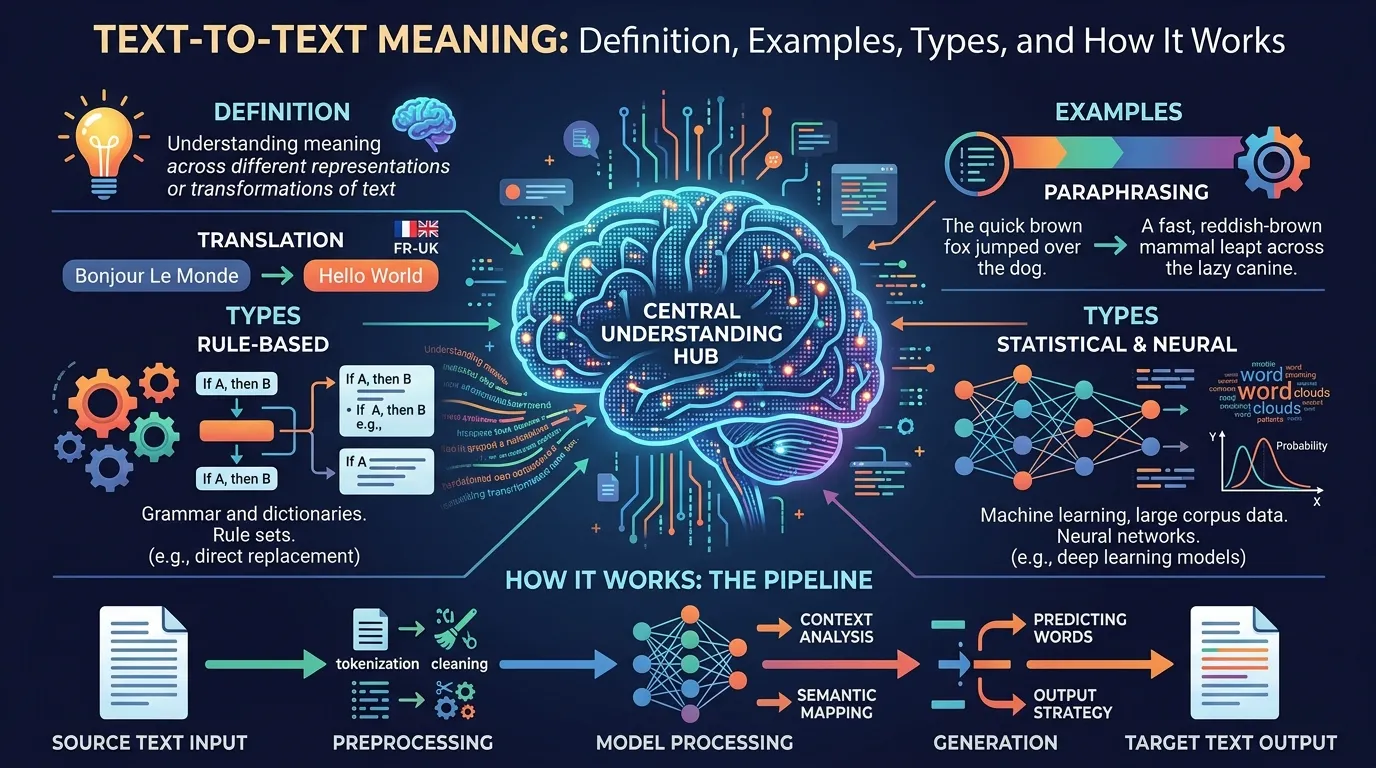
When you hear the phrase “text to text,” it may sound simple, but its meaning depends heavily on the context. In education, text-to-text connections describe how one text relates to another. In reading and literacy, the phrase helps readers compare ideas, characters, themes, events, or information across books, articles, poems, and other written works. In technology, text-to-text can also describe systems that transform one written input into another written output, such as paraphrasing, translation, summarization, or AI-generated text.
At its most basic level, text to text meaning refers to a relationship or transformation involving written language and another piece of written language. The exact interpretation depends on how the phrase is being used.
Understanding text-to-text connections, text-to-text examples, and the difference between text to text, text to self, and text to world is especially useful for students, teachers, writers, researchers, and anyone trying to understand written information more deeply. It can help readers recognize patterns, make comparisons, evaluate arguments, and develop stronger interpretations.
This guide explains the text to text meaning, its common definitions, origins in literacy education, practical examples, different contexts, benefits, common mistakes, and modern applications. Whether you encountered the phrase in a classroom, reading assignment, AI discussion, or everyday conversation, you will find the meaning and usage explained clearly below.
What Does Text to Text Mean?
Text to text means a connection, comparison, relationship, or transformation between one written text and another text.
In reading education, a text-to-text connection happens when a reader notices that something in one text reminds them of, relates to, contrasts with, or helps explain something in another text.
For example, a student reading The Hunger Games might notice similarities between its themes of power and inequality and those found in another dystopian novel. That is a text-to-text connection.
A simple definition is:
Text to text meaning: A relationship between two or more texts in which a reader compares, connects, contrasts, or uses one text to understand another.
The texts do not have to be books. They can include:
- Novels
- Short stories
- Poems
- News articles
- Essays
- Speeches
- Historical documents
- Websites
- Advertisements
- Films or scripts
- Social media posts
- Academic papers
- Religious or philosophical writings
The important point is that the reader is connecting information or ideas from one text with another text.
Text to Text Meaning in Reading and Literacy
The most common educational meaning of text to text comes from reading comprehension strategies.
When readers make connections, they often use three broad categories:
- Text to text — connecting one text to another.
- Text to self — connecting a text to personal experiences.
- Text to world — connecting a text to real-world events, history, society, or general knowledge.
These connections help readers move beyond simply understanding what a text says.
What Is a Text-to-Text Connection?
A text-to-text connection occurs when something you read reminds you of another text you have previously read, watched, studied, or encountered.
For instance:
“The conflict between the two families in this story reminds me of Romeo and Juliet because both stories involve relationships affected by family conflict.”
This is a text-to-text connection because the reader is using one literary work to understand another.
Why Does Text to Text Matter?
A strong reader does more than remember individual facts. They identify relationships between ideas.
Text-to-text connections can help readers:
- Understand difficult concepts
- Recognize recurring themes
- Compare different perspectives
- Identify similarities and differences
- Analyze characters
- Understand historical context
- Evaluate arguments
- Recognize literary techniques
- Build stronger interpretations
- Remember information more effectively
Instead of treating every text as an isolated piece of information, readers begin to see a larger network of ideas.
Text to Text vs. Text to Self vs. Text to World
One of the most common questions about this topic is the difference between text to text, text to self, and text to world.
| Connection | Meaning | Example |
|---|---|---|
| Text to Text | One text connects to another text | A novel reminds you of another novel |
| Text to Self | A text connects to your personal experience | A character’s experience reminds you of your childhood |
| Text to World | A text connects to real-world knowledge or events | A story about war reminds you of a historical conflict |
| Text to Media | A written work connects to a film, show, song, or other media | A novel reminds you of a movie adaptation |
Example
Imagine you are reading a story about a student moving to a new school.
Text to text:
“This reminds me of another novel where the main character also struggles to fit into a new school.”
Text to self:
“This reminds me of when I moved to a new school.”
Text to world:
“Many students experience challenges when they move because of changes in family circumstances or education.”
Each statement creates a different kind of connection.
Text to Text Examples
Understanding examples is one of the easiest ways to recognize this concept.
Example 1: Comparing Two Novels
Suppose you read two dystopian novels.
The first describes a government controlling citizens’ information. The second describes a society where citizens are prevented from expressing certain opinions.
You might write:
“Both texts show how controlling information can limit people’s freedom.”
That is a text-to-text connection because the interpretation comes from comparing two texts.
Example 2: Comparing Characters
You read one story about a courageous young woman and another about a young woman who faces a similar challenge.
You could observe:
“Both characters demonstrate courage, but they respond to danger differently.”
This is a text-to-text comparison.
Example 3: Comparing Themes
Two poems may have different settings but discuss the same theme, such as loss.
A reader might say:
“Although the poems use different imagery, both explore how people cope with loss.”
Again, this connects one text with another.
Example 4: Comparing Historical Accounts
A student reads two accounts of the same historical event.
One source supports a particular interpretation, while another provides a different perspective.
A text-to-text analysis might identify:
- What both sources agree about
- Where they disagree
- What evidence each uses
- Why their perspectives differ
- Which source provides stronger evidence for a particular claim
This is particularly important in academic research.
How to Make a Strong Text-to-Text Connection
Simply saying “this reminds me of another book” is not always enough.
A strong connection explains why the two texts are related.
Step 1: Identify the First Text
Think about what you are currently reading.
Ask:
- What is the main idea?
- What problem does the text explore?
- What themes appear?
- What does the author want readers to understand?
Step 2: Identify Another Text
Think of something else you have read or studied.
It could be:
- Another novel
- A poem
- A news article
- A historical source
- A textbook
- A speech
- A religious text
- An academic article
Step 3: Find the Connection
Look for similarities or differences in:
- Theme
- Plot
- Characters
- Setting
- Conflict
- Argument
- Tone
- Symbolism
- Historical context
- Author’s purpose
Step 4: Explain the Significance
This is the most important step.
Don’t stop at:
“This reminds me of another story.”
Instead explain:
“This reminds me of another story because both authors show how social pressure can influence individual decisions. However, the characters respond differently, which creates different messages about personal responsibility.”
That is much stronger analysis.
Common Types of Text-to-Text Connections
Text-to-text connections can take several forms.
1. Similarity
Two texts may share a common idea.
For example:
Both texts explore the importance of friendship during difficult situations.
2. Contrast
Two texts may address the same issue from different perspectives.
For example:
One author presents technology as beneficial, while the other emphasizes its potential dangers.
3. Theme
Different texts can explore the same universal theme.
Common themes include:
- Love
- Friendship
- Betrayal
- Freedom
- Justice
- Courage
- Identity
- Family
- Death
- Power
- Equality
- Fear
4. Character
Characters may face similar situations or possess similar traits.
For example, two protagonists may both demonstrate courage but define courage differently.
5. Plot
Two stories may contain similar events or narrative structures.
For example:
Both stories begin with an ordinary character discovering a hidden secret that changes their life.
6. Perspective
Two texts can present the same issue from different viewpoints.
This is especially important when analyzing:
- Historical events
- Political arguments
- News reporting
- Social issues
- Academic debates
7. Evidence
One text can provide evidence that supports or challenges information found in another.
This is common in research writing.
Text to Text Meaning in Academic Writing
In academic contexts, text-to-text analysis often means comparing multiple sources to develop a deeper argument.
Instead of summarizing each source separately, a writer brings sources into conversation with one another.
For example:
Source A argues that social media increases political participation, while Source B emphasizes its role in spreading misinformation. Taken together, the sources suggest that social media can increase engagement while simultaneously creating new challenges for information quality.
This approach is stronger than simply writing:
“Source A says this. Source B says that.”
Academic text-to-text analysis asks:
What happens when these sources are compared?
That question can lead to more sophisticated research.
Text to Text Meaning in Literature
In literature, the concept is closely connected to intertextuality.
What Is Intertextuality?
Intertextuality describes how one text can relate to, reference, echo, challenge, or reinterpret another text.
A modern novel might intentionally borrow an idea from an older work. A poem might reference a famous historical text. A film might reinterpret a classic story.
For example, a modern story may contain:
- A recognizable character archetype
- A reference to mythology
- A biblical allusion
- A quotation from another work
- A familiar plot structure
- A deliberate parody of another text
These relationships can give readers additional meaning.
Text-to-Text Connections vs. Intertextuality
The concepts overlap, but they are not identical.
Text-to-text connection is often used as a reading strategy.
Intertextuality is a broader literary concept describing relationships between texts.
Text to Text Meaning in Technology and AI
The phrase text-to-text also has a technological meaning.
In artificial intelligence and natural language processing, text-to-text systems take text as an input and produce text as an output.
Examples include:
- Text paraphrasing
- Translation
- Summarization
- Question answering
- Grammar correction
- Text classification
- Information extraction
- Text rewriting
- AI-assisted writing
For example:
Input:
“The weather was extremely cold.”
Text-to-text output:
“Temperatures were unusually low.”
Both the input and output are text, but the output performs a transformation.
This differs from text-to-image, where written instructions are transformed into an image.
Text-to-Text vs. Text-to-Image
These terms are especially common in modern AI discussions.
| Type | Input | Output |
|---|---|---|
| Text-to-text | Text | Text |
| Text-to-image | Text | Image |
| Text-to-speech | Text | Audio |
| Speech-to-text | Speech | Text |
| Image-to-text | Image | Text |
| Text-to-video | Text | Video |
For example:
Text-to-text:
“Rewrite this paragraph in simpler English.”
Text-to-image:
“Create an illustration of a mountain village at sunset.”
The first produces written language, while the second produces visual content.
Text to Text Meaning in Chat, Social Media, and Everyday Communication
In casual digital communication, text-to-text can simply describe communication between written messages.
For example, someone might say:
“We went from a phone call to text-to-text communication.”
However, this is less likely to be a specific slang expression than the educational or technology-related meanings.
On platforms such as TikTok, Instagram, Snapchat, Reddit, Discord, and messaging apps, the phrase may appear when users discuss:
- Comparing messages
- Rewriting text
- Translating messages
- Converting one written format into another
- AI writing tools
- Reading comprehension
- Communication through text
Unlike expressions such as “LOL,” “FR,” or “FAFO,” text to text is generally not a slang abbreviation.
Text to Text Meaning in Education
Teachers frequently use text-to-text connections to improve reading comprehension.
A classroom assignment might ask:
“Make a text-to-text connection between the story and another book you have read.”
A good response should identify a specific connection.
Weak Answer
“This story reminds me of another book.”
Better Answer
“The story reminds me of The Giver because both texts portray societies where individual freedom is restricted.”
Stronger Answer
“Both texts portray societies that sacrifice individual freedom in exchange for social stability. However, the authors present this idea differently: one focuses on government control, while the other emphasizes how citizens gradually accept restrictions as normal.”
The final answer demonstrates actual analysis rather than simple recognition.
Why Text-to-Text Connections Improve Reading
Making connections can turn passive reading into active thinking.
When readers compare texts, they are more likely to ask:
- Why are these texts similar?
- Why are they different?
- What does one text reveal about the other?
- Does one author challenge another?
- Which argument is better supported?
- How does the historical context change the meaning?
- What new understanding emerges from the comparison?
These questions encourage critical thinking.
Text-to-text reading can also help students develop stronger vocabulary, comprehension, analytical writing, and evidence-based reasoning.
Text-to-Text Connection Sentence Starters
Students sometimes understand the idea but struggle to begin writing.
These sentence starters can help:
Similarities
- “This text is similar to ___ because…”
- “Both texts show…”
- “Like the author of ___, this writer…”
- “A similar theme appears in…”
Differences
- “Unlike ___, this text…”
- “The two authors differ in how they…”
- “While both texts discuss ___, they disagree about…”
Analysis
- “Reading these texts together suggests…”
- “The connection becomes significant because…”
- “This comparison reveals…”
- “One text helps explain the other by…”
Evidence
- “Both authors provide evidence that…”
- “The first text emphasizes ___, whereas the second…”
- “This idea is supported differently in each text…”
Real-Life Text-to-Text Scenarios
The concept is not limited to school assignments.
Scenario 1: Reading News Articles
You read two articles about the same event.
One emphasizes economic consequences, while another focuses on social consequences.
Comparing them helps you develop a broader understanding.
Scenario 2: Product Reviews
You read three reviews of the same product.
One reviewer praises the battery life, while another complains about the weight.
Comparing the reviews gives you information that one review alone might not provide.
Scenario 3: Research
You read several scientific or academic sources.
Instead of treating each source separately, you identify where researchers agree and disagree.
That is practical text-to-text analysis.
Scenario 4: Literature
You notice that a modern novel resembles a classic story.
You compare their themes, characters, and conflicts to understand what the newer author is doing differently.
Common Mistakes When Making Text-to-Text Connections
Not every comparison is useful.
Mistake 1: Making a Connection Without Explaining It
Simply saying two stories are similar is not analysis.
Better: Explain exactly what they share and why it matters.
Mistake 2: Comparing Only the Plot
Two stories can have similar plots but completely different messages.
Consider:
- Theme
- Character development
- Author’s purpose
- Tone
- Perspective
Mistake 3: Choosing an Unrelated Text
A connection should be meaningful.
If the only similarity is that both stories contain a character named John, the connection probably does not offer much analytical value.
Mistake 4: Ignoring Differences
Strong comparison includes both similarities and differences.
Mistake 5: Replacing Evidence With Opinion
Instead of saying:
“I think these books are basically the same.”
Explain what specific elements create the similarity.
Is “Text to Text” the Same as “Text-to-Text”?
Yes, in most contexts, text to text, text-to-text, and text-to-text connection refer to the same general idea.
The hyphenated form is often preferred when the phrase functions as a compound adjective.
For example:
- “a text-to-text connection”
- “text-to-text analysis”
- “a text-to-text activity”
When used more generally, you may see:
- “Connect text to text.”
- “Make a text to text connection.”
The meaning remains essentially the same.
Text to Text Meaning: Key Facts at a Glance
| Fact | Explanation |
|---|---|
| Basic meaning | A relationship or transformation between written texts |
| Most common educational meaning | Connecting one text with another text |
| Main purpose | Comparison, comprehension, analysis, and deeper understanding |
| Common contexts | Education, literature, research, AI, technology |
| Typical tone | Neutral and academic |
| Common related term | Text-to-text connection |
| Literary connection | Intertextuality |
| Opposite connection types | Text-to-self and text-to-world |
| AI meaning | Text input transformed into text output |
| Examples | Comparing books, analyzing sources, paraphrasing, translation |
| Common mistake | Identifying a similarity without explaining its significance |
Related Terms You Should Know
Understanding nearby concepts makes the meaning clearer.
Text-to-Self
Connecting a text to your personal experience.
Text-to-World
Connecting a text to the broader world, history, culture, or current events.
Intertextuality
The relationship between texts, including references, adaptations, allusions, and reinterpretations.
Comparative Analysis
Studying two or more subjects to identify similarities and differences.
Close Reading
Carefully analyzing the language, structure, evidence, and details of a text.
Context
The historical, cultural, social, or situational information surrounding a text.
Paraphrasing
Restating information from a text in different words while maintaining its essential meaning.
Text Transformation
Changing text from one form into another, such as summarizing, translating, or rewriting.
Frequently Asked Questions
1. What is the simple meaning of text to text?
Text to text means connecting one text with another text. In reading, this usually involves comparing ideas, themes, characters, events, arguments, or information between two or more texts.
2. What is an example of a text-to-text connection?
If you are reading a novel about a character fighting against an oppressive government and it reminds you of another dystopian novel with a similar theme, you have made a text-to-text connection.
3. What are the three types of text connections?
The three commonly taught types are text to text, text to self, and text to world. Text to text connects two texts; text to self connects a text with personal experience; and text to world connects a text with real-world knowledge or events.
4. What does text to text mean in reading?
In reading, it means using one text to help understand or analyze another. Readers might compare themes, characters, arguments, settings, writing styles, or messages.
5. Is text to text a literary device?
Not usually. Text-to-text connection is primarily a reading and comprehension strategy. However, the broader literary concept of intertextuality describes meaningful relationships between texts.
6. What is the difference between text-to-text and intertextuality?
Text-to-text is commonly used in education to describe a reader’s connection between texts. Intertextuality is a broader literary theory describing how texts reference, influence, echo, adapt, or respond to other texts.
7. What does text-to-text mean in AI?
In AI and natural language processing, text-to-text generally means that a system receives written language as input and produces written language as output. Translation, summarization, paraphrasing, and question answering are examples.
8. Is text-to-text the same as comparing two texts?
They are closely related, but a text-to-text connection can be broader than a formal comparison. A reader might notice that two texts share an idea without conducting a detailed comparative analysis.
9. How do I write a text-to-text connection?
Identify something important in the first text, find a meaningful connection with another text, explain the similarity or difference, and describe why the connection matters. Use specific evidence whenever possible.
10. Why are text-to-text connections important?
They help readers develop deeper comprehension and critical-thinking skills. Comparing texts can reveal themes, contradictions, patterns, perspectives, and ideas that may not be obvious when each text is considered alone.
Final Thoughts
The phrase text to text meaning is straightforward once its context is understood. In reading and education, it usually refers to a connection between one text and another text. Readers make these connections by comparing themes, characters, plots, arguments, evidence, perspectives, or messages.
The concept is valuable because texts rarely exist in complete isolation. A novel can echo another novel. A news article can challenge another report. A research paper can support or contradict previous research. A modern story can reinterpret an ancient myth. Even AI tools can perform text-to-text transformations by translating, summarizing, paraphrasing, or rewriting written content.
The key is not merely noticing that two texts have something in common. A meaningful text-to-text connection explains what the relationship is and why it matters.
If you are answering a school question, writing an academic paper, analyzing literature, or simply trying to understand something you have read, ask yourself three questions:
- What does this text remind me of?
- How are the two texts similar or different?
- What do I understand better because I compared them?
Those questions turn a simple observation into genuine analysis.
Ultimately, text to text is about seeing relationships between written ideas. Once you learn to recognize those relationships, reading becomes more than understanding individual words on a page—it becomes the process of connecting ideas, recognizing patterns, questioning perspectives, and building a deeper understanding of the world.